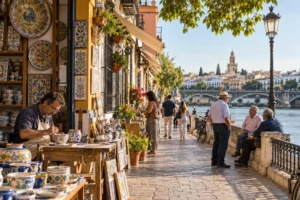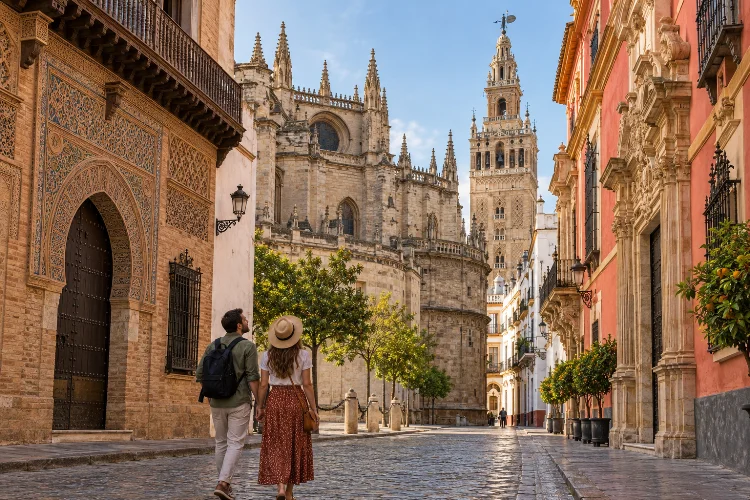
Seville is one of those cities where architecture rarely belongs to a single period.
Walk a few streets through its historic center and you can move from medieval Islamic design to monumental Gothic stonework, Renaissance palaces, elaborate Baroque churches, and bold contemporary structures without needing public transport.
That makes an architectural walking tour through Old Seville one of the best ways to understand the city.
Instead of simply ticking famous attractions off a list, you can see how different rulers, religions, merchants, artists, and architects continuously reshaped the same urban landscape.
A good route does require some planning. Seville’s historic center is compact, but major monuments can take hours to explore, while the maze-like streets of Santa Cruz can easily distract you from your original itinerary.
The trick is creating a route that balances landmark interiors with streets, façades, courtyards, plazas, and smaller architectural details.
Here is how to build a walking tour that reveals Seville one layer at a time.
Start at Plaza del Triunfo for Seville’s Architectural Timeline
Plaza del Triunfo is an ideal starting point because several of Seville’s most important buildings stand within a remarkably small area.
Here you will find Seville Cathedral and the Giralda beside the Real Alcázar and Archivo de Indias. The three form Seville’s UNESCO-listed monumental ensemble, giving you an immediate introduction to Islamic, Gothic, Renaissance, and later architectural influences.
Begin by walking around the square rather than immediately entering a building. Look at differences in scale, stone, window proportions, decorative density, and how each structure interacts with the surrounding public space.
This simple exercise makes the rest of the tour more interesting because you begin reading buildings instead of merely photographing them.
Allow around 20–30 minutes outside before deciding which monument deserves a longer interior visit.
Study the Giralda and Cathedral as Layers of History
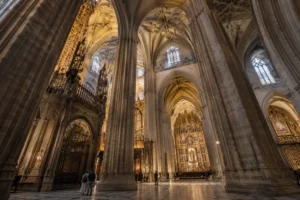
Seville Cathedral provides perhaps the clearest example of architecture evolving rather than simply being replaced.
The cathedral was constructed beginning in the early 15th century on the site of the city’s 12th-century Almohad Great Mosque.
Important elements of that earlier complex survived, especially the former minaret that became the Giralda and the Patio de los Naranjos.
The result is more fascinating than a purely Gothic building.
Study the enormous Gothic volume of the cathedral, then compare it with the geometric decoration of the Giralda’s lower sections and its Renaissance bell structure above. The tower is essentially an architechtural timeline standing in plain sight.
If you go inside, budget at least 90 minutes. Climbing the Giralda is especially useful for an architecture-focused trip because the elevated viewpoint reveals Seville’s dense roofs, courtyards, church towers, narrow streets, and changing urban scale.
For serious architecture enthusiasts, a cathedral rooftop visit can also offer closer views of buttresses and structural elements that are difficult to appreciate from ground level.
Compare Royal and Civic Architecture Around the Alcázar
Next, walk toward the Real Alcázar.
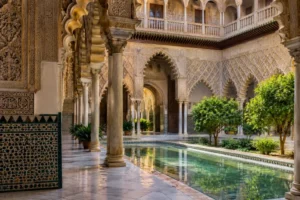
The complex developed across centuries and incorporates Islamic, Mudéjar, Gothic, Renaissance, and Baroque elements. Its origins reach back to a medieval fortified complex, while later rulers repeatedly expanded and transformed it.
One highlight is the 14th-century Mudéjar palace commissioned by Peter I. Rather than viewing its decoration merely as something beautiful, pay attention to repeating geometry, carved plaster, tiled surfaces, arches, courtyards, water, and transitions between interior and exterior rooms.
The nearby Archivo de Indias creates an interesting contrast.
Originally constructed as a merchants’ exchange before eventually becoming an archive, its restrained Renaissance design feels dramatically different from the Alcázar’s highly decorative interiors.
The building later became the repository for vast collections relating to Spain’s overseas territories.
Comparing these structures helps explain how architecture communicated different purposes: royal authority, religion, administration, trade, and empire.
Wander Through Santa Cruz Instead of Following the Fastest Route
After the monumental zone, change your approach completely.
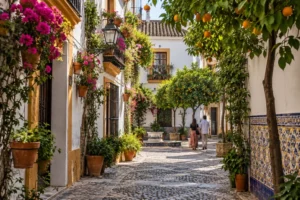
Enter the Santa Cruz quarter and stop worrying about the most direct route. Its narrow lanes, white façades, secluded squares, courtyards, wrought-iron balconies, ceramic decoration, and orange trees provide a more intimate lesson in urban design.
Santa Cruz developed from part of medieval Seville’s Jewish quarter, and its winding street network remains one of the defining characteristics of the area.
Walk through areas around Callejón del Agua, Plaza de Doña Elvira, Plaza de los Venerables, and Plaza de Santa Cruz.
Here, architecture is less about monumental façades and more about climate and everyday living.
Narrow streets provide shade, interior patios bring light and ventilation into buildings, while fountains, plants, tiles, and screened windows create comfortable transitions between private and public areas.
Look through open entrances where public access is clearly allowed, but remember that many attractive courtyards remain private residences.
This section should feel slower and a little unplaned. Getting mildly lost is almost part of the experience.
Add Casa de Pilatos for Mudéjar and Renaissance Design
From Santa Cruz, continue northeast toward Casa de Pilatos.
This palace is particularly valuable because it shows what happened when local Mudéjar traditions met ideas arriving from Renaissance Italy.
Official Seville tourism describes the building as a major example of Andalusian Mudéjar-Renaissance architecture, with Gothic, Islamic, Renaissance, and later Baroque elements appearing throughout the complex.
The palace began developing in the late 15th century and was expanded by generations of the Enríquez de Ribera family.
Its central courtyard deserves time. Notice the arches, classical sculpture, columns, richly patterned azulejo tiles, gardens, wooden ceilings, and the balance between symmetry and decoration.
Casa de Pilatos also demonstrates why simply categorizing Seville’s buildings as “Moorish” or “European” misses the point. The city’s architectural identity frequently emerged from styles being borrowed, adapted, and combined.
Give yourself roughly an hour if you visit the interior.
Use El Salvador to Understand Seville Baroque
Continue toward Plaza del Salvador for a dramatic change in style.
The Church of El Salvador stands on a site with layers stretching through Roman, Visigothic, Islamic, and Christian Seville. The present church was largely constructed between the late 17th and early 18th centuries, producing one of the city’s major Baroque interiors.
Its relatively controlled exterior does not fully prepare you for what is inside.
Baroque architecture aims to create emotional impact through movement, ornament, sculpture, dramatic spatial composition, and visual intensity.
El Salvador makes an excellent counterpoint to the geometric repetition and refined surface decoration seen earlier in Mudéjar buildings.
Spend time examining the altarpieces rather than rushing from chapel to chapel.
Outside, Plaza del Salvador is also perfect for a short break. Grab a drink or coffee and look back at the façade from across the plaza; distance often makes building proportions much easier to understand.
Finish at Las Setas for a Modern Architectural Contrast
An Old Seville walking tour does not have to end with old architecture.
Continue north toward Plaza de la Encarnación, where the Metropol Parasol – usually called Las Setas – creates one of the strongest visual contrasts in the historic center.
Designed by German architect Jürgen Mayer and inaugurated in 2011, the large timber structure rises above an archaeological site and traditional market.
Its program combines the Encarnación Market, public spaces, the Antiquarium archaeological museum, restaurants, and an elevated viewpoint.
The structure demonstrates one of the most interesting questions in historic-city design: should new architecture imitate its surroundings or intentionally contrast with them?
Stand at street level first and study how the huge canopy interacts with surrounding historic façades. Then, if time allows, go to the upper walkway.
From above, you can look back across the cathedral, Giralda, domes, church towers, and dense rooftops you passed earlier.
It creates a satisfying visual summary of the entire route.
Plan the Timing, Distance, and Practical Details
For a relaxed architectural walk, allow roughly four to six hours.
The physical walking distance is not particularly demanding – roughly a few kilometres depending on detours – but interior visits can dramatically extend the schedule.
Trying to properly visit the Cathedral, Alcázar, Casa de Pilatos, churches, and museums on the same day could turn an enjoyable walk into a rushed marathon.
A smarter option is choosing two major interiors and observing the others primarily from outside.
Start in the morning when temperatures and crowds are generally easier to manage. Comfortable shoes are essential because historic paving can be uneven, and carrying water becomes especially important during Seville’s warmer months.
Also check opening hours and tickets shortly before travelling. Religious services, holidays, seasonal schedules, restoration work, and special events can change access.
Most importantly, leave gaps in your itenerary. A doorway, courtyard, tiled façade, tiny church, or unexpected plaza may end up becoming the most memorable part of the walk.
Planning an architectural walking tour through Old Seville is less about creating the longest possible list of monuments and more about understanding how the city developed layer by layer.
Start around Plaza del Triunfo to explore the Cathedral, Giralda, Alcázar, and Archivo de Indias.
Slow down through Santa Cruz, examine the Mudéjar-Renaissance fusion of Casa de Pilatos, experience Seville’s Baroque character at El Salvador, and finish beneath the contemporary curves of Las Setas.
The route turns more than a thousand years of changing architecture into a walkable story.
So wear comfortable shoes, keep your schedule flexible, and remember to look beyond the headline attractions. In Seville, the smallest courtyard, old wall, decorative tile, or forgotten side street can be just as intresting as the famous buildings.