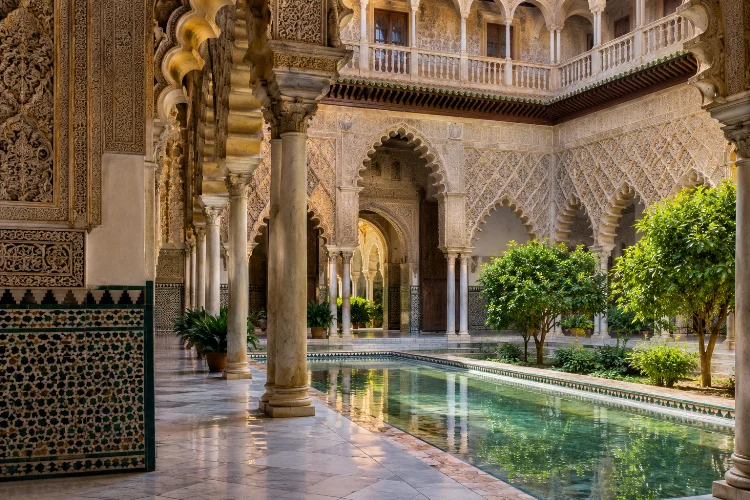
At first glance, the Royal Alcázar of Seville looks like a perfect example of Islamic architecture.
Horseshoe arches, geometric tiles, carved plaster, reflecting pools, and sheltered courtyards seem to tell a clear story. Look closer, though, and that story becomes much more complicated.
The palace is really a collection of architectural conversations taking place across centuries.
Muslim rulers established the site’s early palatial traditions, Christian monarchs reused and transformed them, Mudéjar craftsmen blended Islamic techniques with Christian royal symbolism, and later generations added Gothic, Renaissance, Baroque, and European garden ideas.
UNESCO describes the Alcázar as a rare combination of cultural traditions, with Almohad remains existing alongside Pedro I’s Mudéjar palace and later architectural styles.
Discovering the Royal Alcazar’s hidden architectural influences therefore requires more than admiring beautiful rooms.
You need to notice how different periods overlap, sometimes within the same courtyard. Once you start looking for those layers, the palace becomes far more interesting than any single architectural label suggests.
The Alcázar Began Long Before the Famous Mudéjar Palace
Many visitors associate the Royal Alcázar almost entirely with King Pedro I’s spectacular 14th-century palace. Yet the site’s architectural history reaches several centuries further back.
According to the Alcázar’s official history, a major government enclosure known as the Dar al-Imara was established here in 913 under Abd al-Rahman III.
Later Muslim dynasties expanded the palatial complex, including the Almoravids and especially the Almohads during the 12th century.
Some surviving spaces still preserve traces of this earlier world. The Patio del Yeso, for example, provides an important link with Almohad palace architecture, while the historic garden layouts also preserve ideas rooted in medieval Andalusi design.
This matters because Pedro I did not create his palace on an empty site. He inherited an established language of courtyards, water, shade, enclosed gardens, and carefully controlled movement between public and private rooms.
In other words, some of the Alcázar’s most recognizable features began as part of an older Mediterranean and Islamic architectural tradition.
Mudéjar Design Was a Cultural Blend, Not Simply “Moorish Style”
The most famous section of the complex is the Palacio de Pedro I, built during the 14th century for the Christian king Peter I of Castile.
Calling the building simply “Moorish,” however, misses the most interesting part of its story.
Pedro ruled a Christian kingdom, but his palace deliberately used artistic traditions closely associated with Islamic Iberia.
Mudéjar craftsmen employed carved plasterwork, wooden ceilings, patterned tiles, Arabic inscriptions, polylobed arches, and complex geometric decoration within a palace serving a Christian monarch.
The result was not a direct continuation of Muslim rule but a new cultural synthesis.
The influence of the Nasrid court in Granada is particularly important. Artistic ideas circulated between Christian Castile and Muslim Granada more freely than a simple political map might suggest.
That is why the palace feels culturally layered. Architecture here was being used to communicate prestige, authority, sophistication, and royal legitimacy rather than strict religious identity.
This mixture is the heart of the Alcázar’s architechtural character.
The Patio de las Doncellas Reveals Multiple Eras at Once
Few places demonstrate the palace’s layered history better than the Patio de las Doncellas.
At ground level, the courtyard is dominated by Mudéjar arches, intricate plaster decoration, ceramic surfaces, and a long central water feature. Its composition follows traditions closely connected with Andalusi courtyard architecture.
But look upward and the visual language changes. The upper level belongs to a later Renaissance intervention.
Classical columns, rounded arches, and more European proportions were introduced above the medieval courtyard during the 16th century. Instead of erasing the older architecture, the new gallery was placed directly on top of it.
The result is essentially two historical periods occupying the same visual frame.
Even the garden itself has a complicated history. Archaeological research helped recover the medieval sunken garden arrangement that visitors see today after centuries of later alteration.
The Alcázar is therefore not frozen in a single moment; excavation and restoratoin continue to affect how its history is understood.
Take a minute here instead of simply photographing the pool. The contrast between the two levels is one of the clearest demonstrations of changing cultural influance in the entire complex.
Gothic Architecture Shows the Priorities of Christian Rule
After Seville was conquered by Castile in 1248, Christian rulers did not simply abandon the existing palatial complex.
They adapted it.
Alfonso X commissioned what is now known as the Gothic Palace during the 13th century. Although parts of its organization continued to respond to older structures, its interiors introduced architectural forms more closely associated with Christian European court culture.
The palace included large ceremonial spaces and Gothic ribbed vaulting, creating a very different feeling from the more intimate courtyards and richly surfaced rooms elsewhere in the Alcázar.
Official educational material from the monument notes that surviving rooms preserve elements of the medieval Gothic palace alongside later tile decoration and modifications.
Walking directly from Pedro I’s palace into these rooms makes the contrast especially useful.
Mudéjar spaces often emphasize surface, repetition, shadow, and decorative detail. Gothic interiors feel heavier and structurally more assertive.
Yet both belong to the same royal residence. That contrast is exactly what makes the Alcázar unusual.
Renaissance Ideas Quietly Reshaped the Medieval Palace
By the 16th century, Seville had become deeply connected with Renaissance culture and the growing Spanish imperial world.
Rather than demolishing the medieval Alcázar, rulers continued modifying it.
Classical proportions, Renaissance galleries, sculptural elements, new ceramic decoration, and reorganized palace spaces appeared alongside older Mudéjar rooms.
The upper level of the Patio de las Doncellas is perhaps the most obvious example, but Renaissance influence extends much further through the complex.
These interventions changed how royal spaces were presented without completely replacing their earlier identity.
That creates an interesting visual tension. Classical European ideas based on order and symetry sit beside geometric Islamic-derived decoration that operates according to a very different artistic system.
The Alcázar therefore shows how Renaissance Spain could embrace new Italian-inspired architecture while continuing to value the prestigious Mudéjar tradition inherited from medieval Iberia.
Instead of one style defeating another, they often coexist.
The Gardens Combine Islamic and Italian Traditions
The hidden influences become even clearer once you step outside the palace rooms.
Water channels, enclosed planting areas, pools, fruit trees, and shaded spaces reflect traditions associated with Islamic and medieval Andalusi gardens. Water was not only decorative; it contributed sound, movement, reflections, irrigation, and cooling.
But today’s gardens are not simply preserved medieval landscapes.
Research published by the Royal Alcázar explains that the gardens evolved through centuries of intervention.
During the reign of Philip II, older Muslim orchard spaces were transformed with Italian Mannerist influences, including smaller interconnected gardens inspired by European giardini segreti, or “secret gardens.”
Later additions brought still more influences, including Renaissance structures, Baroque elements, Neoclassical features, and eventually landscape ideas from later European gardening traditions.
This explains why walking through the gardens can feel completely different every few minutes.
One section feels enclosed and intimate; another opens dramatically around fountains or long vistas. Rather than searching for one “authentic” style, notice how each generation reused what came before.
Small Details Reveal the Biggest Cultural Connections
The most rewarding architectural discoveries are often easy to miss.
Look closely at the azulejos covering lower walls. Examine the geometric patterns in carved plaster. Notice Arabic calligraphy appearing within a Christian royal palace, then compare it with coats of arms and Christian symbols nearby.
Wooden ceilings are another important detail. Many use elaborate interlocking geometric systems inherited from Islamic carpentry traditions, even when installed in rooms commissioned by Christian rulers.
Doorways also deserve attention. Moving through the Alcázar often means passing through a sequence of framed views rather than seeing an entire room immediately.
Courtyards reveal themselves gradually, creating a sense of discovery and controlling how visitors experience light and space.
Water performs a similar role. Pools and fountains reflect façades, emphasize visual axes, soften the couryard atmosphere, and connect architecture with gardens.
These elements may appear decorative individually, but together they reveal something larger: the Alcázar’s identity emerged through centuries of cultural exchange rather than architectural isolation.
Why the Alcázar Is Best Understood as a Living Architectural Archive
Perhaps the most important hidden influence is time itself.
The Alcázar was never completed in the way a modern building might be considered finished. Kings repaired it, expanded it, redesigned gardens, changed interiors, added upper floors, and adapted old rooms for new political circumstances.
UNESCO highlights this coexistence of Almohad, Mudéjar, Renaissance, and later architecture as one of the qualities that makes the complex exceptional. The building also retains its historic royal function, remaining a royal residence when Spain’s monarchy is in Seville.
That makes the Alcázar closer to a physical archive than a monument from one period.
Its walls record changing ideas about power, beauty, religion, climate, craftsmanship, and royal life.
Seeing it this way changes the experience completely. You stop asking, “What style is this palace?” and begin asking, “Which period am I looking at now, and what did it keep from the period before?”
Discovering the Royal Alcazar’s hidden architectural influences reveals why the palace is much more than a beautiful example of Mudéjar design.
Its foundations reflect Islamic Seville, its courtyards carry Andalusi planning traditions, its Gothic halls represent Christian royal power, while Renaissance additions and evolving gardens introduce yet another set of ideas.
The most fascinating part is that these influences were rarely separated neatly. They overlap, borrow from one another, and sometimes appear within the same room.
When you visit, slow down and study the details instead of racing between famous photo spots.
Compare upper and lower floors, follow water channels, examine tiles and inscriptions, and watch how one space leads into another. The more carefully you look, the more centuries of Seville begin to appear.