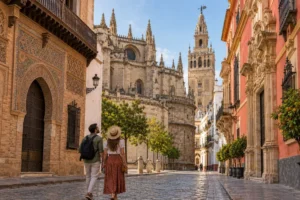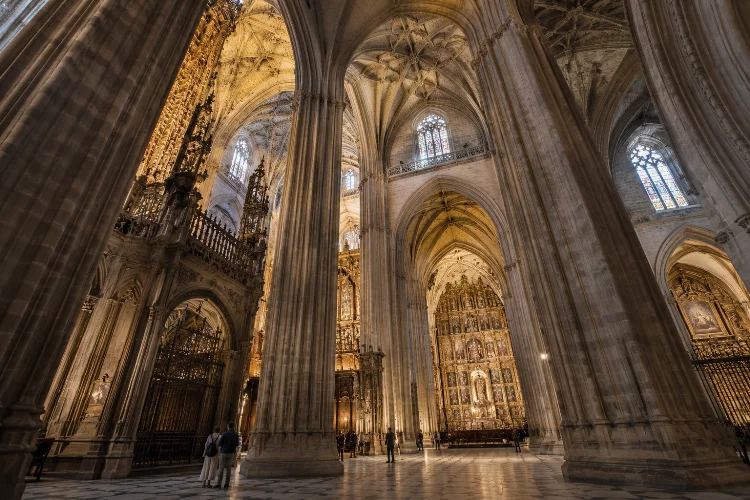
Seville Cathedral is so enormous that the first reaction is usually to look up. Vaults soar overhead, stone columns seem to disappear into the distance, and the Giralda dominates the skyline outside.
But size is only the beginning of what makes this building extraordinary.
Exploring Seville Cathedral and its complex historical layers reveals a monument that was never created in one clean architectural moment.
The site began as part of Almohad Islamic Seville, became a Christian cathedral after the Castilian conquest, and was eventually transformed into a vast Gothic church.
Renaissance architects, Baroque artists, royal patrons, craftsmen, and restorers then continued changing it for centuries. The Giralda and Patio de los Naranjos even preserve major elements of the former mosque.
Instead of thinking of the cathedral as one building from one era, it is more useful to see it as a historical archive built from stone, brick, wood, metal, glass, and centuries of changing ideas.
The Story Begins With the Almohad Mosque
Long before the Gothic cathedral appeared, this site was occupied by Seville’s great Almohad mosque.
During the 12th century, Seville became an important center of the Almohad empire.
The mosque built here reflected that political and religious importance, and two of its most recognizable components survive today: the former minaret, now known as the Giralda, and the courtyard that became the Patio de los Naranjos.
When Christian forces under Ferdinand III captured Seville in 1248, the mosque was converted for Christian worship rather than immediately destroyed.
That period is crucial for understanding the site’s historcal continuity. For more than a century, Christian religious life took place inside a structure originally designed as an Islamic mosque.
The later Gothic cathedral therefore did not begin with an empty plot. Its builders were working within a place already loaded with religious, political, and architectural meaning.
A Gothic Cathedral Replaced Much of the Mosque
By the early 15th century, plans had developed for a far more ambitious Christian cathedral.
Construction of the Gothic building transformed the site into one of medieval Europe’s most remarkable architectural projects.
UNESCO describes the cathedral, with its five naves, as the largest Gothic building in Europe, while the cathedral itself identifies it as the world’s largest Gothic cathedral.
Its scale communicated much more than religious devotion.
Seville had become an important Christian center after the Reconquista, and the new cathedral presented that identity through monumental architechture.
Immense columns, ribbed vaults, chapels, stained glass, and carefully organized interior spaces created a very different experience from the mosque that had previously occupied the site.
Yet the earlier Islamic complex was never completely erased.
This is what makes the building particularly fascinating. The Gothic cathedral represents dramatic tranformation, but its most famous tower and one of its principal courtyards still connect visitors directly to the Almohad city beneath it.
The Giralda Is Two Architectural Worlds in One Tower
The Giralda provides perhaps the easiest place to see Seville Cathedral’s layered identity.
Its lower portion began as the minaret of the Almohad mosque and was completed at the end of the 12th century. Instead of conventional stairs, much of the interior uses ascending ramps around a central core, a distinctive feature that historically made movement through the tower easier.
After the Christian conquest, the former minaret became a bell tower.
Its appearance changed most dramatically during the 16th century, when architect Hernán Ruiz added the Renaissance upper section. The tower was eventually crowned by the Giraldillo, the monumental bronze figure representing victorious Faith.
Look carefully from street level and the stylistic transition becomes visible.
The lower tower carries Almohad decorative traditions, including patterned brickwork, arches, and geometric surfaces. Higher up, Renaissance architectural forms introduce a completely different visual language.
Rather than hiding the transition, the Giralda celebrates it.
The Patio de los Naranjos Preserves the Mosque’s Footprint
The Patio de los Naranjos can seem like a pleasant garden break after the cathedral’s enormous interior. Historically, however, it is one of the most important surviving pieces of the earlier mosque.
The courtyard occupies the former sahn, where ritual ablutions took place before Muslim prayer.
Although the space has been heavily altered, parts of its original organization remain visible.
The cathedral’s official history notes surviving pillars and pointed horseshoe arches, while the fountain occupies the location of the earlier sabil. Remarkably, the upper basin has Visigothic origins and was reused in the Almohad fountain.
That means several historical periods overlap within what looks like a relatively simple courtyard.
The orange trees are linked by irrigation channels arranged into geometric patterns, and water continues to play an important role in shaping the space.
Spend a few quiet minutes here. The contrast between this open, ordered courtyard and the towering Gothic interior next door tells much of Seville’s history without requiring a museum label.
Renaissance Architects Added Another Layer
The cathedral did not stop developing when the medieval construction campaign ended.
During the 16th century, Renaissance architecture introduced new spaces and new ideas. The Main Sacristy, Royal Chapel, Chapter House, and upper portions of the Giralda all contributed to a gradual shift away from purely Gothic forms.
The Chapter House is especially significant.
Designed by Hernán Ruiz, its elliptical interior demonstrates the growing influence of Renaissance concepts such as classical proportion, centralized geometry, and carefully controlled space. UNESCO specifically highlights it as an outstanding Renaissance architectural achievement.
This creates another interesting contrast within the cathedral complex.
Walk from the vertical drama of the Gothic nave into later Renaissance rooms and the design philosophy changes. Instead of medieval complexity and soaring height, you encounter a stronger emphasis on proportion, classical references, and spatial balance.
Seville Cathedral is therefore not just Gothic with a few later decorations. Entire architectural periods remain readable inside it.
The Main Altarpiece Shows How Art Evolved With the Building
Architecture is only part of the cathedral’s historical story.
The enormous Main Altarpiece demonstrates how sculpture, painting, goldwork, and religious storytelling became integrated into the building over generations.
Work began in 1482 with Flemish sculptor Pieter Dancart and continued through several phases involving different artists and workshops.
The final structure reaches nearly 30 meters high and almost 20 meters wide.
Its scale can feel overwhelming, so resist trying to absorb everything at once. Step back first and notice the overall organization, then move visually through individual scenes.
The altarpiece also reflects Seville’s growing wealth and international connections.
Artists and craftsmen from different backgrounds contributed to cathedral projects, while the city’s expanding economic influence provided resources for increasingly magnificient decoration.
During later centuries, Baroque paintings and sculptures added still another visual layer. Works associated with leading Sevillian artists, including Murillo, became part of the cathedral’s extraordinary artistic collection.
Columbus Connects the Cathedral With Seville’s Imperial Age
Another historical chapter appears in the cathedral’s connection with the Americas.
Following Columbus’s voyages, Seville became a major center of Spain’s Atlantic empire and the key trading gateway connecting the monarchy with its American territories.
That global role dramatically increased the city’s wealth and political importance during the 16th and 17th centuries.
Today, the cathedral houses the monumental tomb associated with Christopher Columbus.
Its sculptural arrangement depicts four heraldic figures representing historical Spanish kingdoms carrying the tomb. The present monument has stood inside the cathedral since 1899.
Nearby historical connections extend beyond Columbus himself. His son Hernando Colón built an important collection of books that became closely associated with the Biblioteca Colombina.
These details place the cathedral within a much larger global story involving exploration, empire, knowledge, trade, religion, and colonial expansion.
Earthquakes, Repairs, and Later Changes Kept Shaping the Cathedral
Historic monuments are rarely as unchanged as they appear.
Seville Cathedral experienced structural problems, rebuilding, and repairs throughout its history. In 1511, for example, the original dome over the crossing collapsed and had to be reconstructed. The 1755 Lisbon earthquake also caused damage that required repairs to the Giralda.
Doors, chapels, railings, paintings, tombs, and liturgical spaces continued to change into the 18th and 19th centuries.
That ongoing process explains why trying to assign the entire cathedral a single construction date is misleading.
What visitors see today is the result of centuries of building decisions: some monumental, others almost invisible.
Even conservation work becomes part of that story. Maintaining such a complex monument means constantly balancing structural safety, religious activity, historic authenticity, and access for millions of people interested in its heritage.
How to Explore the Historical Layers Yourself
The best way to visit Seville Cathedral is to avoid treating every space equally.
Start outside so you can understand the building’s scale and identify the Giralda’s different architectural sections.
Then enter the cathedral and spend time comparing the Gothic structural system with the richly decorated chapels rather than simply moving toward the most famous artworks.
When you reach the Giralda, pay attention to the ramps as much as the city views. They reveal how differently the original tower functioned before it became a Christian bell tower.
Finish in the Patio de los Naranjos if your route permits. After the intensity of the cathedral interior, the courtyard provides a quieter place to reconnect the surviving mosque, medieval Christian church, Gothic cathedral, and modern monument.
Check current opening arrangements before visiting, since worship, restoration, religious celebrations, and cultural activities can occasionally affect visitor access.
Exploring Seville Cathedral and its complex historical layers means discovering far more than an enormous Gothic church.
Beneath its present appearance lies the story of an Almohad mosque, Christian conquest, medieval ambition, Renaissance experimentation, Baroque artistic wealth, royal ceremony, Atlantic expansion, and centuries of repair and adaptation.
The Giralda preserves both Islamic and Renaissance architecture.
The Patio de los Naranjos maintains the memory of the mosque courtyard, while Gothic vaults, Renaissance rooms, elaborate altarpieces, royal tombs, and later artworks reveal how the building continued evolving.
When you visit, give those layers time to emerge. Look at transitions between styles instead of chasing only famous highlights. Seville Cathedral becomes far more rewarding once you realize that almost every corner belongs to a different chapter of the city’s story.