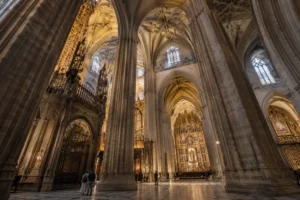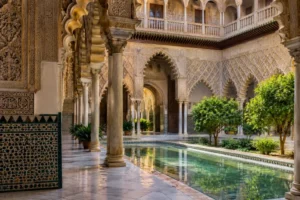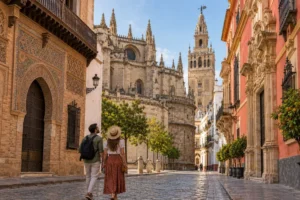
For many visitors, Seville’s historic center means a quick checklist: see the Cathedral, climb the Giralda, tour the Real Alcázar, take some photos, and move on.
Yet just beyond those monumental sights lies a different side of the city – one that rewards people willing to walk slowly and occasionally take a wrong turn.
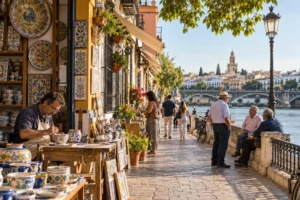
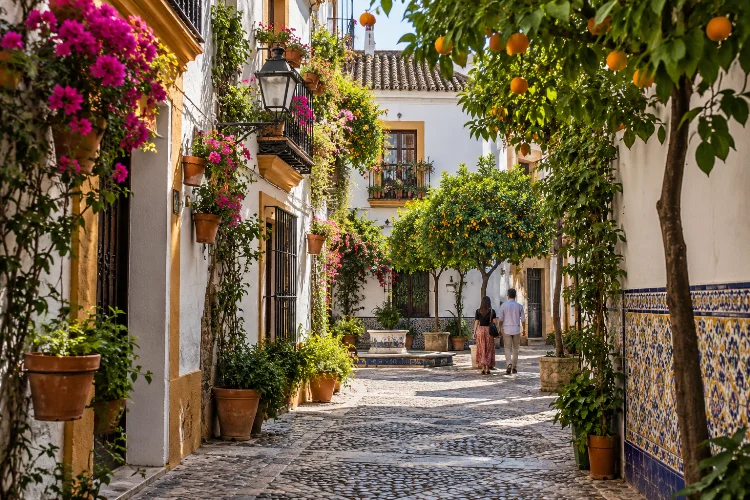
Exploring Seville’s historic Santa Cruz Quarter beyond landmarks means paying attention to narrow passages, flower-filled balconies, orange trees, shaded patios, ceramic tiles, and tiny plazas that appear almost unexpectedly between buildings.
Once part of Seville’s medieval Jewish quarter, this compact area carries centuries of history within a street plan that still feels wonderfully irregular.
The best experiences here are often not marked on a sightseeing map. Santa Cruz is about atmosphere as much as architecture.
Give yourself time to wander without constantly checking directions, and the neighborhood starts revealing details that rushed visitors rarely notice.
Understand Santa Cruz Before You Start Walking
Santa Cruz sits in the heart of Seville’s historic center, beside some of the city’s most internationally recognized monuments.
The Cathedral, Alcázar, and Archivo de Indias form a UNESCO-listed monumental ensemble, but the surrounding residential streets add another layer to understanding how this part of Seville developed.
During the Middle Ages, the wider area encompassing present-day Santa Cruz, Santa María la Blanca, and San Bartolomé formed part of Seville’s Jewish quarter.
Santa Cruz tourism authorities describe it as home to an important Sephardic community before the expulsion of Jews from Spain in 1492.
Knowing that history changes the way you walk through the neigborhood. The twisting layout stops feeling simply picturesque and begins to feel like evidence of many different periods layered on top of each other.
Let Yourself Get Lost in the Narrow Streets
One of the easiest mistakes in Santa Cruz is trying to navigate it too efficiently.
Forget efficiency for an hour.
The area’s charm comes from its labrynthine collection of lanes, passages, small squares, and sudden turns. Streets that seem to lead nowhere may open onto a courtyard, fountain, tiny church, or peaceful plaza.
Official tourism material even highlights the narrow layout as part of the neighborhood’s character and notes how these confined passages can provide cooler conditions during Seville’s hot weather.
Callejón del Agua is a good example. Running beside the walls of the Alcázar, the lane takes its name from its historical role in carrying water toward the royal complex.
Don’t make it your only target, though. Wander through Calle Vida, Calle Gloria, Calle Susona, and the smaller connecting passages. The interesting part is often the transition between streets rather than one particular destination.
Slow Down in the Small Plazas
Santa Cruz works particularly well when explored as a series of pauses rather than a continuous walking route.
Plaza de Doña Elvira is surrounded by traditional architecture, orange trees, and café terraces, while Plaza de los Venerables offers another intimate space surrounded by historic buildings.
The city’s tourism office specifically recommends these squares as places to sit and absorb the atmosphere rather than simply pass through.
Plaza de Santa Cruz tells an even deeper story. The present square occupies the site of an earlier church, which itself had been constructed over a former synagogue.
The church was demolished during the French occupation in 1810, and the square was later redesigned in the early twentieth century.
These layers are easy to miss when you’re focused on photographs.
Sit for ten minutes instead. Listen to conversations, watch people cross the square, and notice how shade, trees, benches, balconies, and surrounding buildings turn these small spaces into everyday extensions of the street.
Look for Courtyards, Tiles, Balconies, and Doors
Santa Cruz’s architecture becomes more interesting when you stop looking only upward at monuments.
Look through open doorways whenever it is appropriate to do so. Traditional Andalusian houses often organize living spaces around interior patios, helping provide shade and ventilation during warm months.
Santa Cruz is particularly known for hidden courtyards decorated with plants, fountains, ironwork, and colorful ceramics.
Blue-and-white tiles, elaborate window grilles, heavy wooden doors, flower pots, and balconies add personality to otherwise simple façades.
Naturally, remember that many buildings remain private homes. Admire visible details from public spaces, avoid blocking entrances, and don’t treat residential courtyards as public attractions unless they are clearly open to visitors.
That small amount of awareness makes exploring more respectful and usually more rewarding.
Discover the Quarter’s Jewish Heritage
Santa Cruz’s romantic image can sometimes overshadow its more complicated history.
A useful place for understanding this past is Santa María la Blanca, just beyond the most heavily visited lanes. According to Seville’s tourism authority, the site was originally a 13th-century synagogue.
Following anti-Jewish violence and forced conversions in 1391, it became a Christian church and was later extensively rebuilt during the seventeenth century.
That transformation reflects the dramatic religious and social changes that affected medieval Seville.
Rather than treating the Jewish quarter as merely a beautiful backdrop, spend time reading historical plaques and looking for traces of former walls, street boundaries, and religious buildings.
Doing so gives a much richer understanding of why Santa Cruz looks the way it does today.
It also prevents centuries of real history from being reduced to a romantic travel story.
Eat and Drink Without Chasing Famous Addresses
Food is another way to experience Santa Cruz beyond its sightseeing circuit.
The busiest streets around major monuments contain countless restaurants, but walking a few blocks deeper into the quarter can reveal smaller taverns and relaxed cafés.
Instead of automatically choosing the restuarant with the biggest terrace, look for places where the menu stays focused on Andalusian dishes and locals actually stop for lunch.
Try familiar regional options such as salmorejo, espinacas con garbanzos, grilled seafood, jamón, croquetas, or seasonal tapas.
Timing matters too. Lunch and dinner in Seville often happen later than visitors from northern Europe or North America expect. Taking your time over several small dishes fits the local rhythm better than rushing through one large meal before returning to sightseeing.
Even a simple coffee in a quiet square can become more memorable than another scheduled attraction.
Visit Early Morning or Around Sunset
Santa Cruz is one of Seville’s most visited areas, so timing can completely change the experience. The official city tourism site acknowledges the area’s high visitor numbers and encourages respectful behavior toward residents.
Early morning offers a particularly different atmoshpere. Delivery workers are preparing businesses, shutters are opening, streets are quieter, and the stone lanes feel far more residential.
Late afternoon and early evening are equally appealing. Warm light reaches the façades, temperatures become more comfortable, and plazas gradually fill with people heading out for drinks and tapas.
During warmer months, avoid building your entire walking route around midday. The nearby Murillo Gardens provide greenery and shade, although Seville’s tourism office also advises avoiding the strongest summer heat even there.
Connect Santa Cruz With the Murillo Gardens
Instead of leaving the neighborhood immediately after exploring its streets, continue toward the Murillo Gardens.
Located beside Santa Cruz and the Alcázar walls, the gardens were once associated with the royal palace grounds. Their modern layout was designed in the early twentieth century and includes pathways, fountains, ceramic benches, orange trees, magnolias, and large ficus trees.
The contrast is refreshing. After enclosed streets and narrow alleys, the gardens offer more open space and greenery.
Plaza de los Refinadores, positioned near the transition between Santa Cruz and the gardens, also contains a monument connected with the fictional Don Juan Tenorio, one of several literary associations attached to this part of Seville.
It’s an easy extension that adds variety without requiring another major attraction ticket.
Exploring Seville’s historic Santa Cruz Quarter beyond landmarks is really about changing your pace.
The famous monuments surrounding the neighborhood are extraordinary, but Santa Cruz becomes far more memorable when you notice the quiet plazas, centuries-old street patterns, hidden patios, Jewish heritage, ceramic details, local taverns, and ordinary routines happening between them.
Don’t worry about creating a perfect walking itinerary. Choose a starting point, put your map away occasionally, and allow enough time to follow whichever narrow street looks interesting.
The best Santa Cruz experience may not be something you can circle on a tourist map. It might simply be finding a shaded plaza, ordering a coffee, and watching Seville unfold around you.
So once you’ve seen the headline attractions, stay a little longer and explore what lies between them.