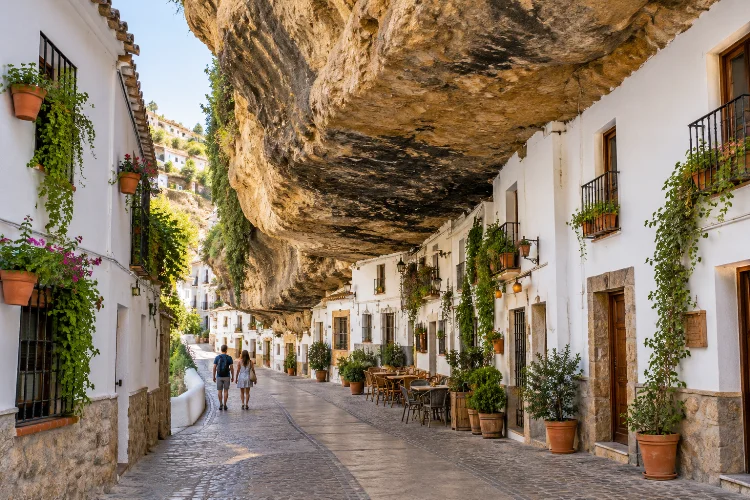
Some towns are built beside mountains. Setenil de las Bodegas looks as if it has been built directly inside one.
Hidden in the Sierra de Cádiz, this unusual Andalusian white village follows a narrow river gorge where enormous layers of rock project over streets, houses, cafés, and small shops.
Instead of removing the cliffs to create space, generations of residents adapted their homes to the terrain. In many places, the rock itself becomes a roof or rear wall.
Discovering the cliffside architecture of Setenil de las Bodegas is therefore less about seeing conventional cave houses and more about understanding how people learned to cooperate with a difficult landscape.
Cádiz tourism describes houses here as standing beneath, above, and even within the rock, producing several levels of streets across the settlement.
The famous Cuevas del Sol and Cuevas de la Sombra are the obvious highlights, but the architectural story becomes even more interesting once you climb toward the medieval upper town.
The Gorge Determined How Setenil Was Built
Setenil would probably look completely different without the Guadalporcún River and the gorge it helped shape.
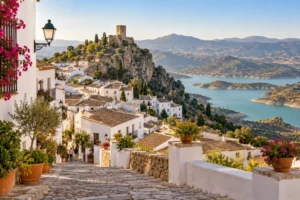
The settlement descends from its hilltop castle toward the river, where erosion created dramatic rock overhangs. Rather than constructing a standard street grid on flatter ground, residents fitted homes and roads into the available spaces.
Andalusia’s official tourism guide describes the lower part of town as particularly distinctive because houses use the natural shelter created by the rocks of the river gorge. Many are classified as semi-troglodytic dwellings rather than fully excavated underground homes.
That distinction matters.
People often say Setenil’s houses are “carved into the mountain,” but many buildings actually work differently. A façade closes the open side beneath a natural rock shelter, while the cliff itself forms much of the ceiling and rear enclosure.
Setenil’s own municipal architectural route explains that these homes take advantage of naturally existing cavities rather than simply digging complete rooms into solid rock.
In other words, geology became part of the construction system.
Cuevas del Sol Shows Architecture Under the Rock
Cuevas del Sol is probably Setenil’s most photographed street.
On this side of the gorge, white façades run directly beneath a massive overhanging rock. Cafés and restaurants occupy some of the spaces today, creating the slightly surreal experience of eating lunch with several metres of limestone seemingly suspended above you.
The street’s name, meaning “Caves of the Sun,” reflects its sunnier orientation compared with the opposite side of the river.
What makes the street architecturally interesting is how little separation exists between building and landscape. There is no conventional roofline in some sections. Instead, the rock continues above several individual properties as one enormous natural canopy.
Look at the junction between white masonry and stone.
That boundary reveals how builders inserted doors, windows, walls, and domestic rooms beneath an irregular geological surface rather than forcing the terrain into a standard rectangular form.
The result is vernacular architechture in its purest sense: buildings responding to the place where they were constructed.
Cuevas de la Sombra Creates a Completely Different Street
Cross the river and the atmosphere changes.
Cuevas de la Sombra translates roughly as “Caves of the Shade,” and parts of the street are covered so dramatically by rock that the experience can feel almost tunnel-like.
Cádiz tourism identifies both Cuevas del Sol and Cuevas de la Sombra as defining examples of Setenil’s unusual multi-level urban landscape.
The difference between the two streets demonstrates something important about the settlement: local architecture responds to microclimate.
Natural stone provides substantial thermal mass. Setenil’s official tourism material notes that its cave houses naturally regulate their internal temperature, one reason this building type has remained practical across generations.
That does not mean every interior maintains exactly the same temperature, but thick surrounding rock can reduce the extreme fluctuations experienced by buildings exposed directly to summer sun or winter cold.
Long before modern insulation and air-conditioning, the landscape itself was helping control indoor conditions.
These Are Houses, Not Just Tourist Curiosities
It is easy to walk through Setenil and treat the rock dwellings as an architectural theme park.
They are not.
Municipal heritage information explains that cave houses historically served as modest family homes.
Some have since become restaurants, storage areas, garages, shops, or tourism businesses, while others – particularly in streets such as Herrería and Jabonerías – have continued their residential function.
That mix is part of what makes the town engaging.
Look beyond the busiest streets and you will see washing, balconies, doorways, plants, parked cars, family entrances, and everyday details integrated into extraordinary geology.
The practical arrangement also varies from house to house.
Some properties extend deeper beneath the rock, while others use only a shallow sheltered area. Additional floors may rise in front of or above the natural cavity where terrain allows.
There is no single standardized “Setenil house.”
Instead, each building negotiates with its own section of cliff.
Climb to La Villa to Understand the Medieval Town
The lower rock streets attract most visitors, but Setenil’s architecture makes more sense when you climb toward La Villa.
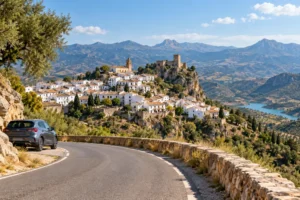
This upper district was the medieval fortified core. The municipal history identifies the area as the location of an Almohad settlement protected by a castle, around which the later town developed.
The surviving fortress remains include a medieval tower and cistern, while the surrounding walls help explain why the upper position was strategically valuable. Cádiz tourism dates the medieval fortress principally to the 14th and 15th centuries.
The contrast with the river streets is striking.
Down below, architecture seems to disappear underneath rock. Up here, buildings dominate the skyline and take advantage of elevation for defense.
Walking between the two areas shows how Setenil’s urban form developed vertically.
You are not simply touring one unusual neigbourhood. You are moving between a fortified medieval settlement above and a river-based landscape of adapted dwellings below.
Christian Architecture Added Another Historical Layer
Setenil changed significantly after Christian forces captured the town in 1484.
The conquest followed repeated attempts to take what had been considered a strategically difficult fortress on the frontier with the Nasrid Kingdom of Granada. Municipal history records several unsuccessful sieges before the final campaign succeeded.
Later buildings added new architectural traditions without erasing the unusual urban setting.
The Church of Nuestra Señora de la Encarnación began construction around the late 15th and early 16th centuries. Setenil’s cultural authority describes it as late Gothic, while other Christian buildings and hermitages gradually expanded the town beyond its earlier fortified core.
The former town hall is another detail worth finding.
Probably built in the early 16th century, it preserves a Mudéjar timber ceiling and now houses the tourist office.
These buildings make Setenil more than a collection of cave houses. Gothic, Mudéjar, medieval Islamic, and popular architecture overlap within a remarkably compact area.
Whitewash Makes the Geology Even More Dramatic
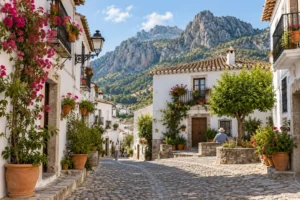
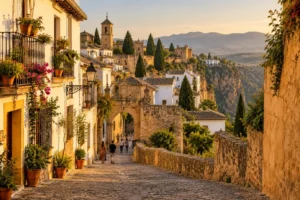
Setenil belongs to Cádiz’s celebrated Pueblos Blancos, or White Villages.
Whitewashed façades are common across inland Andalusia, but here they create an especially dramatic contrast. Bright walls appear almost pasted against rough brown and grey stone.
The visual effect also makes the construction easier to understand.
You can clearly see where human architecture ends and natural architecture begins.
Traditional whitewashing also had practical benefits. Light-colored surfaces reflect strong sunlight, while lime-based coatings historically provided an inexpensive protective finish that could be renewed regularly.
Add dark window bars, timber doors, terracotta roof tiles, flowers, and giant rock formations, and even a simple façade becomes visually rich.
The surprizing thing is how restrained many houses actually are. Most are not architecturally elaborate in the conventional sense.
The drama comes from their relationship with the land.
Walk Beyond the Two Famous Cave Streets
Cuevas del Sol and Cuevas de la Sombra deserve attention, but stopping there gives you an incomplete picture.
Setenil’s municipal cultural information highlights streets such as Herrería, Jabonerías, and Cabrerizas alongside its famous cave areas.
Climb slowly through these connecting streets.
You will find houses squeezed into steep slopes, stairways replacing conventional roads, retaining walls merging with domestic façades, and buildings positioned at completely different elevations despite being only a few metres apart horizontally.
Then look backward.
Some of the best architectural views occur when you gain height and can see how one row of houses sits above another while the gorge cuts through the center.
This is when Setenil stops looking like a series of strange individual buildings and begins to make sense as an entire urban system shaped by topography.
Visit Slowly and Choose the Right Time
Setenil has become one of the major tourism destinations of the Sierra de Cádiz, and its compact streets can feel busy during popular day-trip hours.
Arriving earlier in the morning gives you more room to study the architecture rather than simply moving through crowds.
Spring and autumn are particularly comfortable for exploring the White Villages. Spain’s official tourism portal recommends these milder seasons for walking through the region without the strongest summer heat.
Wear comfortable shoes because Setenil is steep.
Instead of trying to park beside the most famous streets, leave the car in an appropriate public parking area and explore on foot. Walking is part of the experiance because changes in elevation reveal architectural relationships that are impossible to appreciate from a vehicle.
Give yourself at least several hours rather than treating the town as a 30-minute photo stop.
Discovering the cliffside architecture of Setenil de las Bodegas reveals a town where nature was not cleared away before construction began. It became part of the construction.
At Cuevas del Sol and Cuevas de la Sombra, enormous rock overhangs function as roofs and shelter.
Elsewhere, semi-troglodytic homes, steep lanes, medieval walls, a hilltop fortress, Gothic religious buildings, and Mudéjar details show how different generations adapted the same difficult terrain.
The best way to experience Setenil is therefore to look beyond its famous photo spots.
Walk underneath the cliffs, climb toward La Villa, explore the quieter residential streets, and keep turning around to see how the buildings fit together.
Once you understand the landscape, Setenil’s unusual architecture feels less like a novelty and more like an ingenious response to place.