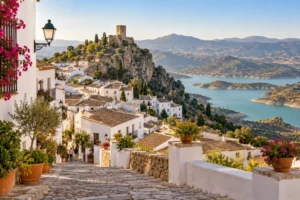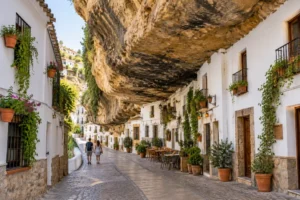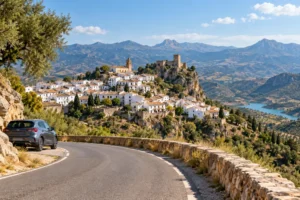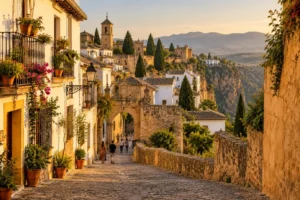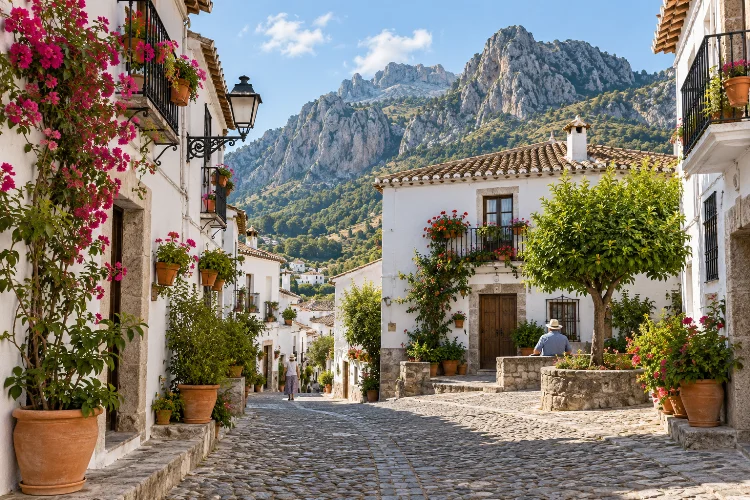
Grazalema is the kind of place where the mountains never feel far away.
Walk down one cobbled lane and a rocky peak appears between whitewashed houses; turn another corner and you find a tiny plaza, wrought-iron balconies, clay roof tiles, or a viewpoint opening toward the Sierra.
Located in Cádiz Province within the Sierra de Grazalema Natural Park, the village is one of Andalusia’s classic Pueblos Blancos.
Its historic center is protected as a cultural heritage site, and Spain’s official tourism portal highlights its alleys, squares, traditional architecture, mountain viewpoints, and long-established textile craftsmanship.
Exploring Grazalema’s traditional streets and mountain heritage is therefore about more than photographing a pretty white village.
The settlement has developed through a close relationship with rainfall, livestock, wool production, water-powered crafts, religious architecture, and the dramatic limestone landscape around it.
Slow down, and those connections become visible almost everywhere.
Start by Reading the Traditional Street Pattern
Grazalema’s historic core is compact enough to explore without a detailed itinerary.
The municipal tourism authority describes the village as a combination of narrow cobbled streets, white lime-coated houses, tiled roofs, and small squares shaped by different periods of settlement.
Many houses traditionally rise only two floors, creating a human-scale streetscape that feels noticeably different from larger Andalusian towns.
The street pattern is part of the experience.
Rather than following one broad avenue, you move through short lanes, corners, slopes, and sudden openings. Plaza de España acts as a central point, but the surrounding streets are often more interesting when explored without trying to reach somewhere quickly.
Look closely at the façades. White walls reflect strong summer light, while iron window grilles, wooden doors, balconies, flower pots, and terracotta roofing introduce texture and color.
The architechture is relatively simple, but simplicity is exactly what allows the mountain setting to remain so visually dominant.
Spend Time Around Plaza de España
Eventually, many walks through Grazalema lead back to Plaza de España.
The square functions as one of the village’s main social and architectural centers. It is surrounded by cafés, traditional buildings, and some of the town’s most significant religious heritage.
Nearby stands the Church of Nuestra Señora de la Aurora, an 18th-century Baroque building identified by Cádiz tourism as one of Grazalema’s principal monuments. Other notable churches include San José, San Juan, and Nuestra Señora de la Encarnación.
Do not treat the plaza simply as a waypoint between attractions.
Sit for a coffee and notice how people use the space. Historic squares make more sense when they are understood as everyday gathering places rather than outdoor museums.
Early morning is especially pleasant, while late afternoon brings a softer light to the white façades.
From the center, wander outward again through the surrounding neigbourhood rather than taking the quickest route back to your car.
Look for the Wool Heritage Behind Grazalema’s Identity
Grazalema’s mountain history is closely tied to wool.
The local Merina Grazalemeña sheep historically provided meat, milk, and high-quality wool.
Municipal tourism material explains that the combination of plentiful water, green mountain pastures, and local sheep supported a significant textile industry, particularly the manufacture of blankets and wool cloth.
Water was especially important.
During the 18th century, streams helped power machinery and supported processes involved in cleaning and preparing wool. Some of the techniques survived into modern production, although electricity eventually replaced hydraulic power.
The local textile museum preserves machinery used for spinning, weaving, and finishing traditional blankets, offering a useful reminder that Grazalema’s heritage developed from work as much as architecture.
This history changes how you see the village.
A wool blanket in a local shop is not simply a souvenir. It connects grazing, rainfall, animals, water, craft skills, trade, and the mountain economy.
Understand Why Water Matters So Much Here
Grazalema has an unusual reputation for southern Spain: rain.
The surrounding mountains intercept moisture carried inland from the Atlantic, producing exceptionally high rainfall. Official Spanish tourism information reports annual precipitation exceeding 2,000 millimetres in parts of the Sierra de Grazalema.
That water helped shape local livelihoods.
Streams powered mills, supported textile production, irrigated small agricultural areas, and created the greener landscape that distinguishes the Sierra from many drier parts of Andalusia.
The broader municipality also includes Benamahoma, where the old watermill ecomuseum documents historic uses of water for flour mills, olive processing, wool fulling, bakeries, and other traditional activities.
Rain also influences the feel of the village itself.
Grazalema can be misty and dramatic even when lower areas of Cádiz are sunny. Clouds moving through the limestone peaks create an atmoshpere that feels almost unexpected for southern Spain.
That climate is not background scenery – it helped create the culture visitors see today.
Step Outside the Village to Understand the Mountains
You cannot fully understand Grazalema by staying inside the historic center.
The village sits within the Sierra de Grazalema Natural Park, a protected landscape stretching across Cádiz and Málaga provinces.
The region contains limestone mountains, deep gorges, caves, Mediterranean woodland, and important stands of Spanish fir, or pinsapo. It was designated a UNESCO Biosphere Reserve in 1977.
The mountains rise dramatically around the settlement, reaching between roughly 600 and 1,600 metres across the wider reserve.
One of the most distinctive trees is the Abies pinsapo, a rare fir whose surviving Andalusian forests are strongly associated with these mountains.
You do not need to complete a difficult hike to appreciate this landscape.
Even short walks or viewpoints around the village reveal limestone ridges, valleys, pasture, and forest. Puerto del Boyar is particularly useful for understanding how Grazalema sits within the larger mountain system.
Once you see the terrain from above, the village’s narrow streets and sheltered position begin to make much more sense.
Combine the Streets With a Carefully Chosen Walk
Grazalema makes an excellent base for hiking, but trail access deserves some planning. Some routes in protected reserve areas require prior authorization.
The El Pinsapar trail, for example, crosses the Spanish fir forest and currently requires permission; from June 1 to October 15, access is more restricted because of fire risk and is limited under specific guided conditions.
This is why it is worth checking official park information shortly before your visit rather than relying on an old blog itinerary.
For a more relaxed trip, spend the morning exploring the village and dedicate the afternoon to an easier nearby route or viewpoint.
That balance works particularly well because the cultural and natural heritage explain each other.
Inside town you encounter wool, whitewashed houses, water, and traditional food. Outside, you see the rainfall, pastures, livestock country, forests, and mountains that allowed those traditions to develop.
The experiаnce feels much more complete when both sides are included.
Use the Viewpoints to Read the Landscape
Grazalema’s viewpoints are not simply places for panoramic photographs.
They help explain why the town developed where it did.
The Andalusian Institute of Historical Heritage describes Grazalema as occupying a distinctive position between the Cumbres and Peñón Grande mountains, with the Guadalete River and associated orchards, mills, and former cloth-making activity contributing to the cultural landscape.
From elevated positions, look beyond the rooftops.
Notice where the white houses stop and the slopes begin. Follow the valleys visually, and look for pasture or areas where water naturally gathers.
This relationship between settlement and landscape is one reason Grazalema feels different from white villages built on exposed hilltops.
Its identity is not based only on white walls. It comes from being physically enclosed by mountains and closely connected to their resources.
Eat Like the Mountain Environment Matters
Local food offers another way to understand the Sierra.
Grazalema’s traditional cuisine is closely linked to livestock, pasture, and the practical needs of mountain communities. Merina Grazalemeña sheep historically supplied milk and meat as well as wool, while cheeses from the wider Sierra draw on local goat and sheep farming.
You may also find hearty soups, lamb dishes, cured meats, pastries, and mountain-style cooking that feels noticeably different from seafood-focused Cádiz on the coast.
Do not rush lunch.
Part of the pleasure of visiting a village like Grazalema is allowing enough time for the daily rhythm to slow down.
Choose a small local restaurant, sit longer than necessary, then walk again afterward.
That simple routine fits the town far better than racing through ten landmarks before sunset.
Visit in a Season That Matches Your Plans
Spring is one of the easiest seasons for combining village walks with outdoor activities.
The surrounding landscape is green, temperatures are generally comfortable, and flowers add color to traditional streets.
Autumn is equally appealing, especially for visitors interested in hiking and cooler weather.
Winter can bring cold conditions, heavy rain, and dramatic clouds, but it also reveals exactly why the region’s water heritage is so important.
Summer is usually better approached with an early start. Explore the historic streets in the morning, take a long midday break, and return outdoors later.
Whatever the season, bring appropriate footwear.
Cobbled lanes can be steep, while mountain conditions may change far faster than weather in coastal Cádiz.
Exploring Grazalema’s traditional streets and mountain heritage works best when you stop separating the village from the Sierra around it.
Its whitewashed houses and cobbled lanes reflect generations of local building traditions, while churches and plazas reveal the historic structure of the settlement.
Wool blankets connect Grazalema with sheep farming, abundant water once powered textile activity, and the surrounding mountains continue to shape its climate, food, scenery, and outdoor culture.
Give yourself more than a quick photo stop on a White Villages road trip. Walk slowly through the old center, visit the textile heritage, spend time at the viewpoints, and then head into the surrounding landscape.
Grazalema becomes far more memorable once you see the village and mountains as parts of the same story.