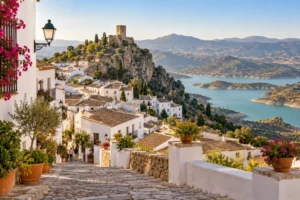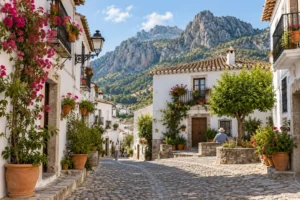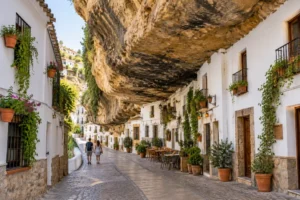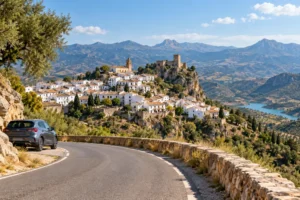
For most first-time visitors, Ronda begins with Puente Nuevo. The enormous stone bridge crossing the Tajo gorge is genuinely spectacular, and its dramatic setting deserves every photograph it receives.
But treating the bridge as the whole story means missing much of what makes Ronda interesting.
Exploring Ronda’s historic neighbourhoods beyond Puente Nuevo reveals a city shaped by medieval Islamic planning, defensive walls, Christian expansion, old palaces, religious buildings, bathhouses, and communities that developed on different sides of the Guadalevín River.
Spain’s official tourism portal notes that Ronda’s historic quarter lies mainly south of the river and retains both Arab architectural influences and a medieval street pattern.
The best way to experience these layers is on foot. Leave the busiest viewpoints behind, follow the narrow streets into La Ciudad, descend toward the old bridges and Arab Baths, then continue through the gates into San Francisco.
Ronda quickly becomes much more than one famous crossing.
Start With La Ciudad, Ronda’s Historic Core
Cross Puente Nuevo toward the southern side of the gorge and you enter La Ciudad, the oldest and most historically layered part of Ronda.
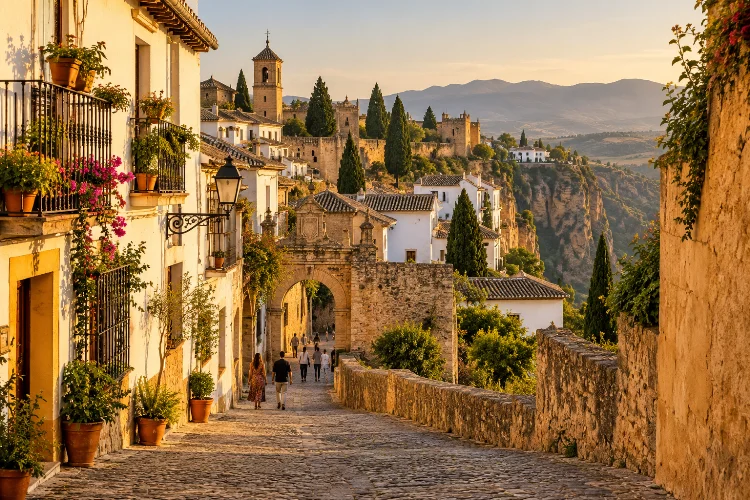
Unlike the broader commercial streets north of the bridge, this quarter retains a noticeably more medievel character. White façades, stone doorways, small squares, old religious buildings, and irregular streets follow the shape of the rocky plateau.
Spain’s tourism authority describes this side of Ronda as the old quarter, where Arab influences remain visible in its architecture and street layout.
The district once formed part of the fortified Islamic medina, protected both by constructed walls and the dramatic natural defenses of the gorge.
Avoid rushing directly between marked attractions. Wander around Plaza Duquesa de Parcent and the quieter lanes surrounding it.
This is where Ronda begins feeling like an inhabited historic town rather than a sightseeing viewpoint.
Read Centuries of History at Santa María la Mayor
One of La Ciudad’s most revealing buildings is the Church of Santa María la Mayor.
The site demonstrates how Ronda’s architectural history accumulated rather than simply replacing one period with another.
During Islamic rule, the main mosque of the medina stood here. After the Catholic Monarchs captured Ronda in 1485, construction began on a Christian church that eventually incorporated Gothic, Renaissance, and Baroque elements.
Evidence of the earlier mosque did not completely disappear. Ronda’s tourism authority notes that part of the mihrab arch and its decorative wall survive within the later building.
That makes Santa María more interesting than a church belonging to one architectural period.
Stand outside first and study how the building relates to the surrounding square. Then, if you enter, compare its different structural and decorative sections instead of searching only for the most impressive altar.
The mixture tells Ronda’s story remarkably well.
Explore Palacio de Mondragón and Its Courtyards
A short walk away, Palacio de Mondragón introduces another side of historic Ronda.
Today it houses the Municipal Museum, whose archaeological collections explore the wider history of the Serranía de Ronda. Andalusia’s official tourism site describes the building as one of the city’s most significant examples of civil architechture.
The palace itself deserves as much attention as the exhibits.
Its courtyards and architectural layers reflect later Mudéjar and Andalusian traditions, while gardens open toward views of the surrounding mountains. The experience is much more intimate than standing above the Tajo with large crowds.
Visiting the museum also gives useful context for everything you see afterward.
Ronda was shaped by multiple populations and historical periods long before it became associated with Romantic travelers, bullfighting, or dramatic Instagram photographs. Understanding that longer timeline makes the surrounding streets much easier to read.
Follow the Old Route Down Toward Puente Viejo
From La Ciudad, begin descending toward the lower part of town rather than immediately returning across Puente Nuevo.
This route takes you through an older network of streets connecting the fortified city with river crossings below. Puente Viejo is far smaller than Puente Nuevo, but that is exactly why it feels different.
Spain’s tourism portal describes the Old Bridge as a single-arch crossing around 10 meters in diameter. Nearby historic routes also include the Arco de Felipe V and the older San Miguel crossing.
From this lower position, Ronda’s geography suddenly makes more sense.
You can see how elevation shaped defense, movement, access to water, and connections between neighborhoods.
The walk can involve steep sections, so comfortable shoes are worthwhile. Take your time, especially when the paving becomes uneven.
The reward is a completely different experiience of the city – less monumental, more physical, and closely connected to the landscape.
Discover Everyday Islamic Ronda at the Arab Baths
Near the old river crossing are Ronda’s Arab Baths, one of the strongest reasons to explore beyond Puente Nuevo.
Dating from the Nasrid period, the complex stood outside the former Islamic medina in an old suburb near a reliable source of water. Andalusia’s tourism authority describes them as among the best-preserved Islamic bathhouses on the Iberian Peninsula.
The surviving complex includes cold, warm, and hot rooms with barrel vaults punctured by star-shaped openings.
Its water engineering is equally interesting. Water was supplied using a waterwheel system, part of which remains preserved.
The baths help shift attention away from rulers and fortresses toward daily urban life.
A hammam was related to hygiene, social interaction, and religious practices. That makes the building a valuable reminder that Islamic Ronda was not simply walls and military architecture; it was a functioning community with complex public infrastructure.
Spend time looking at the ceiling openings. The changing light gives the relatively heavy stone-and-brick structure an unexpectedly delicate atmosphere.
Walk Along Ronda’s Medieval Walls
After the baths, continue toward the surviving defensive walls.
Ronda’s rocky position already provided exceptional natural protection, but its vulnerable approaches required substantial fortifications. Parts of the Islamic-era defensive network remain visible today, especially around the Cijara walls and the southern side of the old city.
Ronda’s official tourism information explains that the medieval Muslim medina was clearly defined by both the Guadalevín gorge and constructed city walls.
Walking beside these remains helps explain the city’s historic shape.
Rather than viewing a gate or wall as an isolated monument, imagine how movement would once have been controlled. Traders, farmers, soldiers, residents, and visitors entered the city through specific access points instead of simply approaching from any direction.
The walls also provide quieter viewpoints over the countryside.
Here, Ronda feels less like a crowded attraction and more like a fortified settlement positioned strategically above a broad Andalusian landscape.
Pass Through Puerta de Almocábar Into San Francisco
At the southern edge of the historic town stands Puerta de Almocábar, one of the most important surviving gateways.
The gate dates mainly from the 13th century and historically provided access to the city from the south. Its name is linked to the Arabic al-maqabir, meaning cemetery, because a burial ground stood outside the walls. A Renaissance entrance was later added during the period of Charles V.
Beyond the gate lies the San Francisco neigbourhood.
This area is useful precisely because it feels less dominated by major sightseeing landmarks. Ronda’s official walking-route information describes San Francisco as a traditional district immediately outside the medieval walls and the gates of Almocábar and Carlos V.
Spend some time around Ruedo Alameda rather than immediately turning back.
Local restaurants, residential streets, small businesses, and neighborhood activity make San Francisco a good place to pause for lunch or coffee.
It provides a natural ending to the historical walk because you have effectively travelled from the famous bridge, through the old medina, and out through one of its historic gates.
Look for Smaller Islamic and Mudéjar Survivals
Ronda contains several smaller monuments that are easy to overlook when attention stays fixed on its gorge.
One is the Minaret of San Sebastián, a surviving element associated with a former Islamic mosque. Spain’s official tourism portal notes its Mudéjar details, including stucco decoration and horseshoe arches.
The city’s tourism guide identifies it as a remnant of one of Ronda’s 14th-century Islamic mosques.
These smaller structures provide an important contrast to Puente Nuevo.
The bridge announces itself from a distance. A surviving minaret, an old wall, or a fragment of Islamic decoration requires closer attention.
That is part of the appeal of exploring Ronda slowly. The city’s most interesting historical evidence is sometimes embedded inside later buildings or hidden beside seemingly ordinary streets.
Look up frequently. Bell towers, old masonry, rooflines, gates, and defensive structures reveal how continous change reshaped the town.
Give Ronda More Than a Quick Day-Trip Checklist
Ronda is often visited as a short excursion from Málaga, Marbella, or the Costa del Sol.
You can certainly see Puente Nuevo and several major sights within a few hours, but a slower visit changes the experience dramatically.
Allow at least half a day for the historic neighborhoods alone.
A practical route can begin at Puente Nuevo, continue through La Ciudad and Palacio de Mondragón, reach Santa María la Mayor, descend toward Puente Viejo and the Arab Baths, follow the walls, and finish through Puerta de Almocábar in San Francisco.
The city’s official tourism material encourages exploring Ronda without rushing, particularly around the old Arab medina and its surviving fortifications.
Leave extra time for spontaneous detours.
An overlooked courtyard, empty lane, old doorway, or quiet café may become more memorable than another scheduled attraction.
Exploring Ronda’s historic neighbourhoods beyond Puente Nuevo reveals a far richer city than the famous bridge alone can show.
La Ciudad preserves a medieval urban pattern shaped by Islamic Ronda, while Santa María la Mayor demonstrates centuries of religious and architectural change.
Palacio de Mondragón adds civil history, the Arab Baths reveal everyday life and water engineering, and the surviving walls and gates explain how the old city functioned defensively.
Beyond Puerta de Almocábar, San Francisco offers a more relaxed glimpse of local life outside the ancient fortifications.
So photograph Puente Nuevo – it deserves the attention. Then keep walking. Follow the older bridges, pass through medieval gates, wander quiet streets, and give Ronda enough time to reveal the neighborhoods behind its most famous view.