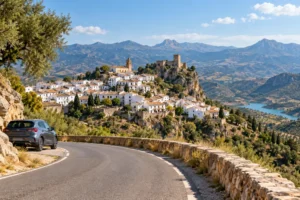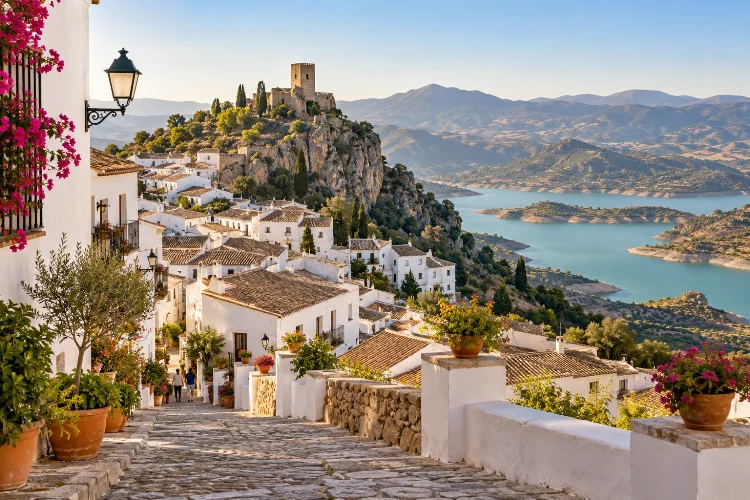
Zahara de la Sierra almost seems designed for postcards. Whitewashed houses tumble down a steep hillside, a medieval tower watches from the rocky summit, and the turquoise Zahara-El Gastor reservoir stretches across the valley below.
It is easy to arrive, take twenty photographs, admire the panorama, and continue to the next Andalusian white village.
That would be a shame.
Learning how to experience Zahara de la Sierra beyond famous viewpoints reveals a much richer destination. The village lies inside the Sierra de Grazalema Natural Park and has been protected as a Historical Site.
Its character comes from a medieval street pattern, surviving fortifications, traditional mountain houses, local cuisine, religious architecture, and its close relationship with the surrounding landscape.
Instead of treating Zahara as a quick photo stop, give it several hours – or preferably most of a day. Walk slowly, climb into its medieval past, taste local dishes, and explore what happens beyond the obvious viewpoints.
Wander the Stepped Streets Without Following a Perfect Route
One of the easiest ways to understand Zahara is simply to stop navigating efficiently.
The village was built along a steep slope, so its streets adapt constantly to changes in elevation.
Zahara’s municipal heritage authority explains that this irregular terrain created stepped streets where views can suddenly disappear behind buildings before reopening into wide panoramas a few metres later.
That makes wandering part of the attraction.
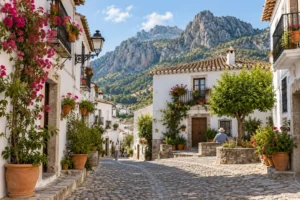
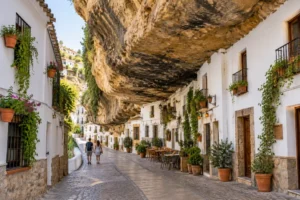
Look for whitewashed two-storey houses, thick irregular walls, flower-covered balconies, tiled roofs, and small passages connecting different levels. Many of these elements belong to the traditional domestic architecture of Cádiz’s mountain communities.
Start near Plaza del Rey, then deliberately take a few side streets instead of heading directly uphill.
The quieter neigbourhood lanes show a different Zahara from the famous roadside panorama. Laundry, plants, old doorways, local shops, and residents going about everyday routines remind you that this is still a living village rather than a preserved film set.
Climb to the Medieval Village, Not Just the Castle View
The Torre del Homenaje is Zahara’s most obvious historical landmark, but the climb is more rewarding when you understand what once surrounded it.
During the medieval period, a fortified settlement occupied the high ground above today’s village.
Surviving remains include walls and the keep, positioned at about 605 metres above sea level. The municipal heritage guide describes the tower as the last defensive refuge within the castle complex.
Rather than racing to the top for another reservoir photo, look at the terrain as you climb.
The defensive logic becomes obvious. Steep rock protected the settlement naturally, while walls controlled the more vulnerable approaches.
Zahara occupied an important frontier landscape during the later medieval struggle between Christian kingdoms and the Nasrid territory of Granada.
The tower itself also shows a mixture of architectural traditions. Municipal documentation notes features associated with both Nasrid military design and later Christian influence.
The panorama is excellent, of course, but understanding why the fortress stands there makes the view much more meaningful.
Explore Zahara’s Religious and Civic Heritage
Back in the lower village, spend time around Santa María de la Mesa rather than immediately returning to your car.
The present church was completed in 1755 under architect and sculptor Antonio Matías de Figueroa. Its Baroque interior contains an 18th-century organ, choir furnishings, and a collection of liturgical objects preserved in the parish museum.
Nearby, the Clock Tower tells another small piece of the town’s story.
It survives from an earlier hermitage dedicated to San Juan de Letrán, while the present chapel beside it dates from the 20th century.
These buildings are useful because they show that Zahara’s history did not stop after the medieval period.
Its architechture continued evolving as religious, civic, and domestic needs changed. Medieval defenses, Baroque churches, traditional mountain houses, and modern community spaces now exist within the same compact settlement.
Visit the Interpretation Centre for the History Beneath the Streets
If you want more context, the Medieval Village Visitor Interpretation Centre is worth adding to your route.
The center occupies a historically layered area associated with the remains of an earlier Christian church that may itself have stood over an Islamic religious site.
Archaeological evidence around the complex also includes remains connected with much older water use and occupation.
That long timeline is important.
Zahara is often presented mainly through its pretty white houses and late-medieval castle, but human activity in this landscape goes much further back.
Visiting the interpretation space before or after climbing the castle can make the surviving ruins easier to understand.
Instead of seeing scattered walls and stones, you begin imagining a functioning fortified community with places of worship, water infrastructure, housing, and defensive zones.
It turns the upper village into archaeology rather than merely scenary.
Eat the Food Connected to the Sierra
A village is difficult to understand properly if you never sit down to eat.
Zahara’s traditional cuisine reflects the straightforward ingredients and cooking styles of inland Cádiz.
Official provincial tourism information highlights local dishes such as quemones de cebolla, made with tomato, onion, and parsley, along with sopas hervías and sweet pastries known as borrachos.
You may also encounter local cheeses, cured meats, olive oil, game, and hearty dishes associated with the wider Sierra de Cádiz.
Instead of choosing lunch solely by whichever terrace has the biggest reservoir view, walk slightly away from the busiest areas and look for a small restaurant serving regional food.
Take your time.
A long lunch fits Zahara better than trying to squeeze another village into the same afternoon. Local food provides cultural context that a viewpoint simply cannot.
If your visit coincides with Corpus Christi, the experience becomes particularly distinctive. Cádiz tourism notes that the celebration is recognized as a Festival of National Tourist Interest and combines elaborate street decoration with local culinary traditions.
Spend Time Around the Reservoir Instead of Only Looking at It
The Zahara-El Gastor reservoir usually appears in photographs as a bright blue background beneath the village.
It is worth going down to water level.
The reservoir supports outdoor recreation, while the Arroyomolinos Recreational Area includes an artificial inland beach commonly known as La Playita. Cádiz tourism specifically identifies the area for swimming and other leisure activities in the Sierra.
Elsewhere around the reservoir, activities can include canoeing and other water-based recreation. Official Sierra de Grazalema visitor information also highlights canoeing on the reservoir as one way to experience the landscape.
Even if you are not interested in swimming, visiting the reservoir changes your perspective.
From below, the castle and white village appear high above you, and the relationship between Zahara, the rock, surrounding farmland, and water becomes much clearer.
It is the reverse of the famous viewpoint – and sometimes the more interesting one.
Explore Sierra de Grazalema Beyond the Village Streets
Zahara sits inside one of Andalusia’s most dramatic protected landscapes, so it makes sense to combine cultural exploration with nature.
One of the area’s best-known routes is Garganta Verde, a deep gorge associated with spectacular limestone scenery and important birdlife.
Zahara’s municipal heritage information notes that the municipality contains a major griffon vulture colony, along with several other birds of prey.
However, Garganta Verde is not a casual trail you should simply arrive at and enter.
The Junta de Andalucía currently requires administrative authorization for the route, and access conditions vary depending on the section and season. Current official information also warns about hazards such as falling stones and slippery surfaces.
Check the latest park rules before planning your walk.
If you prefer something less demanding, you can still enjoy short drives, designated viewpoints, or easier walks through the surrounding Sierra without turning your visit into a major hiking expedition.
The important thing is to experience Zahara as part of a mountain landscape, not as an isolated white village.
Stay Into the Evening if Your Schedule Allows
Day-trippers often arrive around late morning, climb to a viewpoint, eat lunch, and disappear.
Staying later changes the atmosphere.
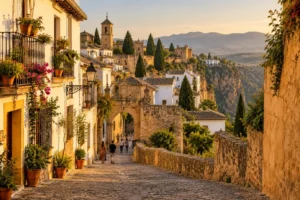
As traffic decreases and the strongest afternoon light fades, the narrow streets become quieter. White façades take on warmer tones, the mountains appear softer, and Plaza del Rey becomes a place to sit rather than somewhere to pass through.
An overnight stay creates an even better experiance.
Early morning lets you walk through the village before most visiting cars arrive. You can hear church bells, watch businesses open, and explore the hillside streets without feeling pressured to keep moving.
This slower rhythm also makes Zahara a practical base for exploring Grazalema, the natural park, or nearby white villages on another day.
Sometimes the easiest way to get beyond famous viewpoints is simply to be there when everyone else has left.
Knowing how to experience Zahara de la Sierra beyond famous viewpoints means treating the village as more than a spectacular landscape photograph.
Its stepped streets reveal traditional mountain architecture, while the medieval fortress explains Zahara’s strategic past.
Churches and archaeological remains add later and earlier historical layers, local dishes connect visitors with Sierra culture, and the reservoir offers an entirely different perspective from below.
Beyond the houses, the Sierra de Grazalema opens the door to walking, wildlife, and dramatic limestone landscapes.
Take the famous photographs, but do not make them the purpose of your visit. Give Zahara several hours, follow streets without checking the map constantly, sit down for local food, and explore the landscape around it.
The village becomes much more memorable once the viewpoint is only the beginning.