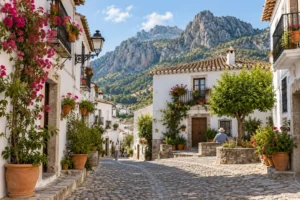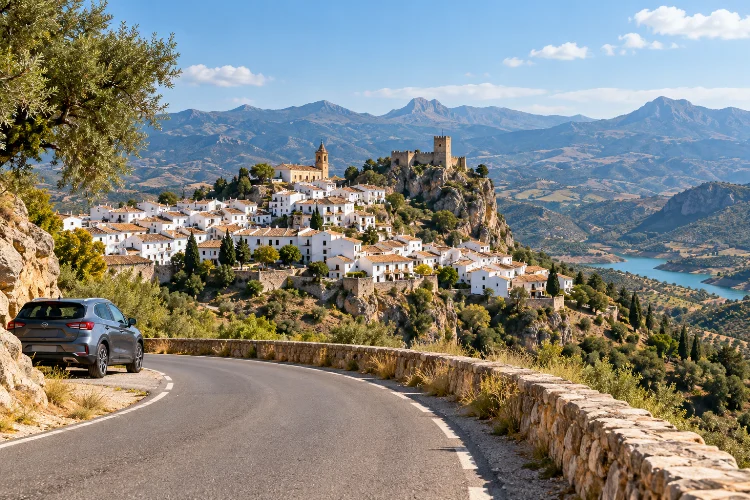
There is something addictive about driving through the mountains of Cádiz and suddenly seeing a cluster of white houses appear across a hillside.
A few kilometres later, another village emerges below a castle, beside a reservoir, or squeezed beneath enormous limestone cliffs.
A White Villages road trip through Cadiz Province is one of the best ways to explore inland Andalusia beyond the better-known coastal cities.
The traditional Pueblos Blancos combine Moorish street plans, medieval fortifications, mountain scenery, local food, craft traditions, and some surprisingly dramatic roads.
The challenge is deciding where to stop. Cádiz Province has enough white villages to fill a week, and trying to visit six or seven in one day usually means spending more time finding parking than enjoying them.
Arcos de la Frontera is widely promoted as a gateway to the route, while much of the classic itinerary passes through the Sierra de Grazalema.
The better approach is to slow down and build a route around three or four memorable bases.
Decide How Many Days You Actually Need
You can see a few white villages on a long day trip, but two to four days creates a much better road-trip experience.
For a two-day route, concentrate on Arcos de la Frontera, Grazalema, Zahara de la Sierra, and Setenil de las Bodegas. These destinations provide a strong mixture of old towns, mountains, castles, unusual architecture, and dramatic landscapes.
Three or four days lets you add places such as Ubrique, Olvera, El Bosque, Villaluenga del Rosario, or El Gastor without turning every stop into a race.
This matters because distances can be deceptive. A village may appear only a short distance away on the map, but mountain roads contain bends, elevation changes, viewpoints, cyclists, and slower local traffic.
Think in terms of experiences rather than mileage. Two relaxed villages and a mountain drive can easily fill a day.
Start in Arcos de la Frontera
Arcos makes a logical western starting point, especially if you are arriving from Cádiz, Jerez, or Seville.
The historic center occupies a spectacular ridge above the Guadalete Valley. Cádiz tourism describes Arcos as the gateway to the White Villages Route and notes that its modern urban form owes much to the Muslim period.
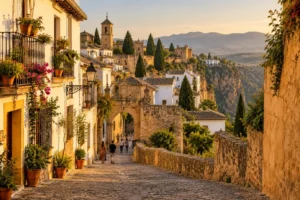
Its old quarter includes steep streets, arches, surviving walls, churches, palaces, and the medieval Matrera Gate.
Do not try to drive deep into the oldest streets unless your accommodation specifically provides suitable access.
Historic Andalusian centers can be extremely narrow, and GPS directions do not always understand that your rental car feels much wider when stone walls are only centimeters away.
Park outside the tightest historic core and walk uphill instead.
Spend several hours wandering the viewpoints, Plaza del Cabildo, and surrounding lanes. Arcos works particularly well as your first overnight stop if you arrive later in the day.
Drive Into the Sierra de Grazalema
From Arcos, continue toward the mountains and the Sierra de Grazalema Natural Park.
The landscape changes quickly. Agricultural plains give way to limestone ridges, forests, valleys, and steep mountain roads.
The protected area covers more than 50,000 hectares and forms an important part of the White Villages route. Interestingly, it is also unusually wet by Andalusian standards: Cádiz tourism reports annual rainfall above 2,000 litres per square metre in parts of the Sierra.
Grazalema itself is an excellent lunch or overnight stop.
Its whitewashed historic center has been designated a Historical Site, and the village is known for traditional architecture, churches, textile crafts, and its mountain setting.
Allow time to simply walk.
You do not need a checklist of monuments here. Small squares, tiled façades, mountain views, balconies, fountains, and local restaurants are a large part of the attraction.
If you also plan to hike, check current trail conditions and access requirements with the natural park authorities before setting out. Some routes in protected areas can have seasonal rules.
Make Zahara de la Sierra a Major Stop
Few places deliver the classic pueblo blanco image as perfectly as Zahara de la Sierra.
White houses climb a hillside beneath a medieval castle, while the Zahara-El Gastor reservoir spreads across the valley below. The village sits inside the Sierra de Grazalema Natural Park and is officially protected as a Historical Site.
Its modern settlement developed during the Muslim period, and the old town still preserves an Andalusi-style street pattern alongside sections of medieval walls and a 13th-century castle.
Plan at least two or three hours here.
The streets are steep, so comfortable shoes matter. Walking toward the castle provides increasingly good views, although the climb can feel much longer under strong summer sun.
The drive between Grazalema and Zahara is also part of the experience. Roads around Puerto de las Palomas pass through some of the most dramatic mountain scenary in the area.
Official natural-park information confirms access to local trails and viewpoints from the A-372 and CA-9104 mountain roads.
Do not schedule this section too tightly. You will probably stop for photographs.
Add Ubrique for Crafts and a Different Atmosphere
Ubrique makes sense if you want the route to include more than picturesque hilltop views.
Located where the Sierra de Grazalema and Los Alcornocales natural parks meet, the town has a historic center with medieval streets and surviving traces of Roman and Islamic heritage.
Its major distinction is leatherwork.
Ubrique has developed an international reputation for leather craftsmanship, with traditional skills continuing alongside modern production.
That gives the stop a different character from smaller mountain villages.
Spend time exploring workshops and the old quarter rather than simply photographing white façades. Nearby, the archaeological site of Ocuri and an old Roman road offer additional options if history interests you.
Ubrique works particularly well on a three- or four-day itenerary because it adds cultural variety without requiring you to leave the mountain region.
Continue North Toward Olvera
If your schedule allows another full day, drive toward Olvera.
Its skyline is one of the most recognizable in the Sierra de Cádiz. The white town rises below a rocky summit crowned by a castle and the Church of Nuestra Señora de la Encarnación.
The old Villa district occupies the earliest urban core and preserves a maze-like layout connected with the town’s Andalusi past. The castle itself has Muslim origins and dates to the 12th century.
Olvera also works well for travelers who want some activity between drives.
The nearby Vía Verde de la Sierra follows a converted railway corridor through the countryside and is promoted as a roughly 36-kilometre route.
You do not need to complete the entire trail. Even a short walk or bike ride can provide a welcome break after several hours behind the wheel.
Consider staying overnight nearby if you want to see the castle area in softer morning or evening light.
Finish With Setenil de las Bodegas
Setenil is different enough from the other villages that it deserves to be saved for the end.
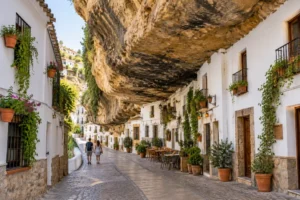
Instead of sitting entirely on top of a hill, much of the town follows a river gorge. Houses are constructed beneath, against, and around huge rock overhangs.
The best-known streets are Cuevas del Sol and Cuevas de la Sombra, where natural rock forms roofs above parts of the buildings. Cádiz tourism notes that the present settlement has medieval origins and developed around an older Almohad site.
Arrive early if possible.
Setenil is popular, and its unusual streets can become busy later in the day. Morning also makes it easier to appreciate the difference between the sunny and shaded sides of the gorge.
Leave your car in a suitable public parking area rather than searching endlessly for a spot beside the famous streets.
The center is compact enough to explore on foot, and walking lets you notice how ingeniously houses have been integrated into the limestone.
From here, Ronda is nearby if you want to continue your Andalusian road trip into Málaga Province.
Plan Driving, Parking, and Fuel Before Each Day
The route is easy enough for confident drivers, but it is not the place to rush.
Mountain roads can be narrow and winding. Villages often contain steep streets, sharp corners, and restricted central areas. A small rental car is usually more comfortable than a large SUV for this type of trip.
Download offline maps before entering the mountains. Mobile coverage is generally available around settlements, but depending completely on live navigation is unnecessary.
Also fill the tank before long mountain sections rather than waiting until fuel becomes urgent.
For parking, follow signs for public lots and walk into historic centers. This is usually faster than attempting to park beside the main plaza.
Most importantly, avoid trusting your navigation app blindly. If a street looks impossibly narrow, there is probably a better route around it.
Choose Spring or Autumn for the Easiest Trip
Spring is arguably the ideal season.
The countryside is greener, flowers brighten whitewashed streets, and temperatures are generally more comfortable for climbing steep village roads on foot.
Autumn is another strong option, particularly if you prefer quieter travel and hiking.
Summer delivers reliable sunshine but can make afternoon exploration tiring. If travelling during hotter months, drive during midday and explore villages in the morning and later afternoon.
Winter can be beautiful and uncrowded, although weather in the Sierra de Grazalema can be much wetter than many visitors expect. The region’s unusual rainfall is one reason its landscape stays so green.
Whatever the season, check weather before driving mountain roads.
A sunny morning on the coast does not always mean identical conditions at higher elevation.
Avoid Trying to Collect Every White Village
The biggest planning mistake is treating the route like a competition.
There are many attractive villages across Cádiz Province, and they begin to blur together if you spend only 30 minutes in each one.
Instead, choose destinations with contrasting personalities.
Arcos provides dramatic urban history. Grazalema gives you mountain culture and nature. Zahara offers a spectacular castle-and-reservoir setting.
Ubrique brings leather craftsmanship. Olvera adds frontier history, while Setenil delivers one of Andalusia’s most unusual forms of vernacular architechture.
That combination already creates a memorable trip.
Leave some gaps in the schedule for roadside viewpoints, unexpected cafés, local bakeries, or short walks.
A road trip should still feel like a road trip.
Planning a White Villages road trip through Cadiz Province is really about balancing driving with enough time to experience each place.
Start with the dramatic ridge-top streets of Arcos, enter the Sierra de Grazalema, slow down in Grazalema and Zahara, then expand the journey toward Ubrique or Olvera before finishing beneath the extraordinary rock overhangs of Setenil de las Bodegas.
Two days will give you a strong introduction, while three or four days creates a much more relaxed journey.
Rent a reasonably small car, avoid overloading your schedule, park outside historic centers, and keep extra time for mountain viewpoints.
Most importantly, do not judge the route by how many villages you manage to tick off. The best moments usually happen when you stop counting and simply enjoy the road.