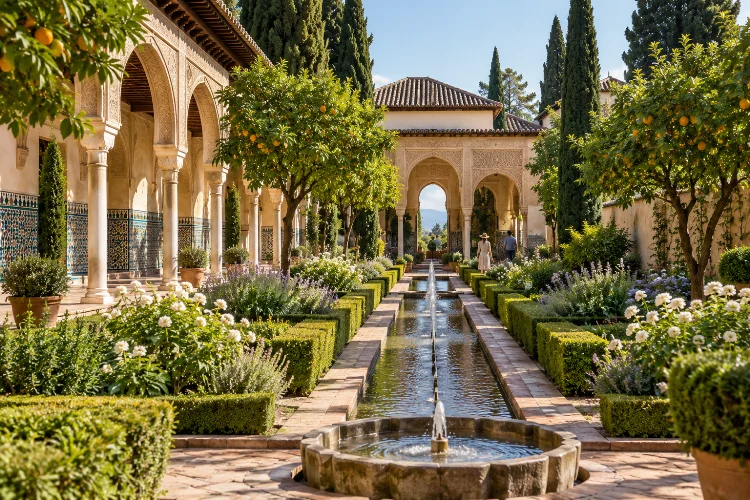
A historic Andalusian garden is rarely just a collection of pretty plants.
Look closely at a courtyard in Granada, Córdoba, or Seville and you will often find water channels guiding the eye, fruit trees providing shade, enclosed walls creating privacy, and paths arranged around surprisingly precise geometric patterns.
These features are closely connected to centuries of Islamic landscape design in Al-Andalus.
From the tenth-century palatial city of Medina Azahara to the Nasrid gardens of the Generalife, designers combined practical irrigation with architecture, agriculture, sensory pleasure, and carefully framed views.
UNESCO describes the Generalife as both a royal retreat and one of the surviving examples of medieval agricultural productivity supported by sophisticated irrigation engineering.
Understanding Islamic garden design across historic Andalusia therefore means looking beyond fountains and flowers.
These landscapes were places for cooling, food production, privacy, ceremony, contemplation, and entertainment – and their influence can still be felt in Andalusian patios and palace gardens today.
Water Was the Structure Behind the Garden
Water may look decorative in Andalusian palace gardens, but historically it was infrastructure first.
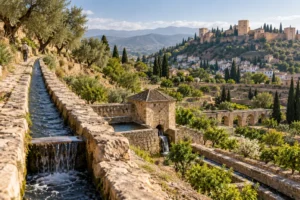
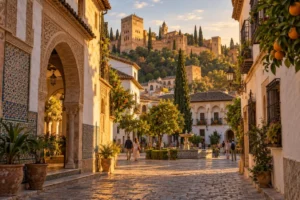
The Alhambra could only develop on Granada’s Sabika Hill because engineers created a hydraulic system capable of bringing water from the Darro River.
The Acequia Real, or Royal Canal, carried water roughly 11 kilometers before distributing it through the Generalife orchards and onward to palaces, fountains, baths, cisterns, houses, and gardens.
Once water reached the site, designers made it visible.
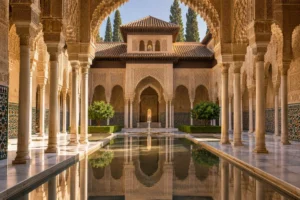
Instead of hiding every irrigation channel underground, they allowed water to move through courtyards, narrow channels, fountains, pools, and reservoirs. This transformed an essential resource into architecture.
Water also cooled the surrounding enviroment, reflected façades, introduced sound, and directed attention toward doors or pavilions. The result was practical and theatrical at the same time.
At the Generalife, reservoirs, channels, wells, and even a waterwheel helped move water toward cultivation areas at different elevations.
Geometry Created Order Without Needing Huge Spaces
Islamic gardens often feel calm because their layouts are highly organized.
Paths, planting beds, water channels, walls, and buildings are frequently arranged around clear axes. Rectangles and squares make the garden easier to irrigate while also producing visual balance.
This approach appears particularly clearly in archaeological evidence from Medina Azahara near Córdoba. Built in the tenth century for the Umayyad caliphate, the palatial city combined architecture, landscape planning, roads, canals, and extensive hydraulic infrastructure.
Its garden areas included rectangular plots divided by paved paths and irrigation channels, with vegetation planted in geometric beds.
Historical evidence used in the site’s UNESCO nomination connects these spaces with broader garden traditions circulating through the Islamic world.
The goal was not rigid uniformity.
Geometry provided a framework within which trees, flowers, water, shade, architecture, and changing seasons could create variety. That mixture explains why a symetrical courtyard can still feel relaxed rather than formal.
The Generalife Combined Beauty With Food Production
Modern visitors often imagine historic royal gardens as purely ornamental landscapes.
The Generalife challenges that idea.
Located above the Alhambra, it served as a rural retreat for Granada’s Nasrid rulers during the thirteenth and fourteenth centuries. Its landscape contained palace gardens but also orchards and agricultural plots supplied through the same sophisticated irrigation network.
UNESCO specifically recognizes these productive areas as an important surviving element of the medieval landscape.
Some Generalife garden areas were divided into terraces because of the sloping terrain. The Royal Water Channel supported vegetable gardens, fruit trees, ornamental planting, and agricultural spaces covering several hectares.
Some historic kitchen gardens have continued to be cultivated in later centuries.
That combination is important.
An Islamic royal garden did not necessarily separate beauty from productivity. Citrus trees could offer fruit, fragrance, color, and shade simultaneously. Herbs might be useful in cooking while also contributing scent and texture.
The landscape worked on several levels at once.
Courtyards Created Private Outdoor Rooms
Not every Islamic garden required a royal estate.
Some of the most influential design principles were used inside ordinary homes.
Historic Córdoba provides an excellent example. The traditional courtyard house turns inward, with rooms arranged around an open patio rather than emphasizing the street façade.
Córdoba’s municipal heritage resources trace this form partly to Islamic domestic traditions, where interior decoration, water, plants, shade, and privacy became central features of family space.
This arrangement also made practial sense in southern Spain’s climate.
A courtyard provided daylight and ventilation while walls reduced direct exposure to busy streets. Fountains, wells, plants, and shaded surfaces could make the interior feel noticeably more comfortable during hot weather.
After Córdoba returned to Christian rule, the basic courtyard arrangement did not simply disappear. It continued evolving through Mudéjar, Renaissance, Baroque, and later architectural traditions.
Today’s famous Córdoba patios are therefore not frozen examples of one historical culture. They are living landscapes created through centuries of adaptation.
Plants Were Chosen for the Senses as Well as Appearance
Islamic garden traditions were intensely sensory.
The experience was not designed only for the eyes. Water created gentle sound, aromatic plants changed the smell of enclosed spaces, and trees produced moving patterns of shade throughout the day.
Fruit-bearing plants were especially useful because they could combine beauty with productivity.
Orange and lemon trees later became strongly associated with Andalusian courtyards, while myrtle, jasmine, herbs, roses, vines, and other vegetation added fragrance and seasonal change.
A good example survives in Córdoba’s Mudéjar courtyard at the Alcázar de los Reyes Cristianos. Its rectangular layout includes ponds, ceramic water channels, orange and lemon trees, myrtle beds, wallflowers, and aromatic jasmine.
The exact planting of medieval gardens is not always known, so it is worth avoiding the idea that every modern flower bed perfectly recreates its Islamic predecessor.
What survives more clearly is the design principle: plants, water, architecture, and climate were meant to work together.
Gardens Controlled Views, Shade, and Privacy
Walls are just as important as flowers when understanding these landscapes.
Enclosure created separation from the outside world, allowing gardens to function as private environments. Visitors might pass through modest entrances before suddenly arriving inside richly planted courtyards.
That contrast was deliberate.
Views were often revealed gradually through arches, doorways, galleries, and elevated terraces.
At the Generalife, the palace occupies changing levels adapted to the hillside, combining enclosed spaces with carefully positioned views toward Granada and the surrounding landscape.
Shade was equally important.
Arcades, walls, vegetation, and narrow circulation routes protected visitors from intense summer sunlight. Because water and plants were concentrated inside these enclosed spaces, the garden could feel almost like an outdoor room.
This helps explain why Islamic garden design frequently feels intimate even within a large palace complex.
The most surprizing views often appear only after moving through several smaller spaces first.
Seville Shows How Islamic Garden Ideas Continued After Conquest
Islamic political rule ended at different times across Andalusia, but its garden traditions did not suddenly vanish.
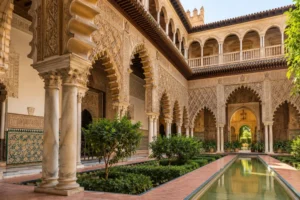
The Real Alcázar of Seville demonstrates this continuity particularly well.
The complex contains centuries of modifications, including Almohad remains, the fourteenth-century Mudéjar palace of Pedro I, and extensive garden alterations carried out under later Christian monarchs.
Its official history emphasizes the continuing importance of gardens and water throughout the palace’s development.
Later designers introduced Renaissance, Mannerist, Baroque, and other European ideas.
Yet older principles survived: enclosed garden rooms, fountains, irrigation, tiled surfaces, citrus trees, shade, and close connections between palace interiors and planted spaces.
This is why describing every historic Andalusian courtyard simply as a “Moorish garden” can be misleading.
Many are hybrids.
Their fascination comes from the way Islamic ideas were preserved, modified, and combined with later architectural traditions instead of being completely replaced.
How to Read an Andalusian Garden When You Visit
You do not need specialist knowledge to understand these landscapes more deeply.
Start with the water.
Look for where it enters, where channels lead, and whether a fountain sits on an important axis. Notice whether pools are primarily decorative or appear connected with a broader irrigation system.
Next, study the geometry. Follow pathways and ask whether the garden is divided into rectangles, crossed by channels, or centered around a fountain.
Then look at the plants.
Are they providing shade, fruit, fragrance, privacy, or decoration? In many historic spaces, one tree can perform several of those roles simultaneously.
Finally, study the relationship between inside and outside. Stand beneath an arcade and see how a doorway frames the garden. Walk toward an elevated terrace and notice when the wider landscape suddenly becomes visible.
Once you begin noticing those relationships, gardens that initially seem decorative become much easier to read.
Understanding Islamic garden design across historic Andalusia reveals landscapes shaped by engineering, climate, agriculture, architecture, and sensory experience.
At Medina Azahara, gardens formed part of a carefully planned caliphal city. In Granada, the Generalife combined royal leisure with orchards, terraces, and sophisticated irrigation.
Córdoba’s courtyards show how inward-facing garden spaces entered domestic life, while Seville demonstrates how Islamic ideas continued evolving under Christian rulers.
The most important lesson is to look beyond flowers.
On your next journey through Andalusia, follow the water channels, notice the shade, examine the geometry, smell the citrus and jasmine, and pay attention to how each view is framed.
Those small details reveal how garden design became one of Al-Andalus’s most enduring cultural legacies.