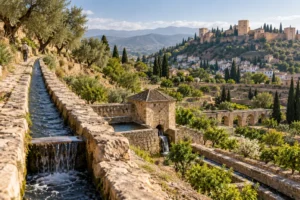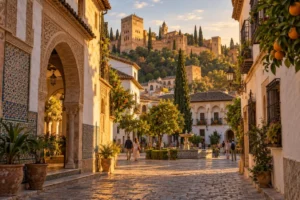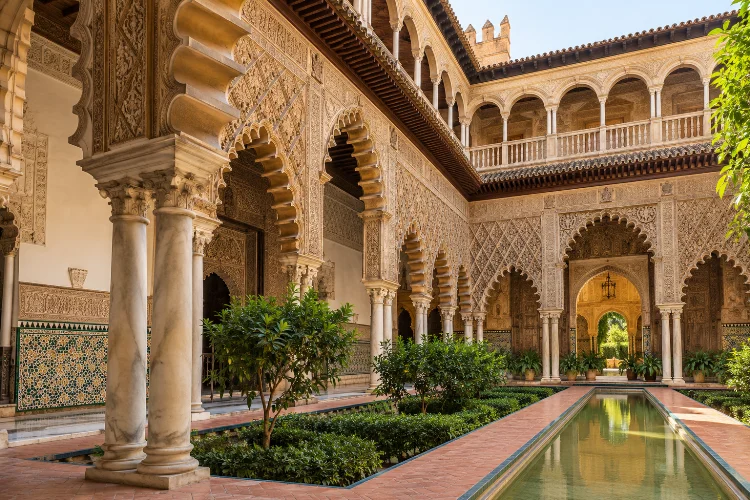
Walk into Seville’s Royal Alcázar and it is easy to assume you have entered a surviving Islamic palace.
Delicate arches frame peaceful courtyards, geometric tiles cover the lower walls, Arabic inscriptions run through elaborate plasterwork, and water reflects façades that seem closer to Granada than medieval Christian Europe.
The story, however, is far more interesting.
Discovering Mudéjar architecture in Seville’s royal palaces means exploring a style created through cultural exchange. After Christian forces captured Seville in 1248, its rulers did not simply reject the artistic traditions of Al-Andalus.
They continued using Islamic-inspired craftsmanship, materials, spatial ideas, and decorative techniques within buildings commissioned for Christian monarchs.
The clearest example is the Palace of Pedro I inside the Real Alcázar. Constructed in the mid-14th century, it sits within a royal complex whose origins stretch back to Islamic Seville and whose buildings later absorbed Gothic, Renaissance, and Baroque influences.
UNESCO describes the Alcázar as an exceptional meeting point between Almohad heritage and Christian Andalusia.
What Mudéjar Architecture Actually Means
Mudéjar is sometimes described simply as “Moorish architecture built by Christians,” but that explanation is a little too simple.
The style developed in Christian-ruled parts of medieval Iberia while drawing heavily on building traditions associated with Islamic Spain.
Craftsmen used materials such as brick, plaster, timber, glazed ceramics, and carved wood to create geometric surfaces, ornamental ceilings, tiled walls, and intricate arches.
The result was not a direct copy of earlier Islamic architecture.
Christian patrons adapted those techniques to their own palaces, churches, monasteries, and civic buildings.
Heraldic symbols and Christian political messages could therefore appear beside Arabic inscriptions, Islamic-derived geometry, and ornamental forms inherited from Al-Andalus.
That cultural combination is exactly what makes Seville’s royal architecture so compelling. The Real Alcázar preserves original Islamic phases alongside the later Mudéjar Palace of Pedro I and buildings from several subsequent European styles.
Pedro I Turned Mudéjar Design Into Royal Architecture
The heart of the story is the palace commissioned by King Pedro I of Castile during the 14th century.
Pedro ruled a Christian kingdom, yet he deliberately chose an architectural language closely connected with Islamic court culture.
The official history of the Alcázar describes his palace as a mid-14th-century return to older Mediterranean ideas expressed through Arabic artistic traditions.
Connections with Nasrid Granada were especially important. Seville tourism sources record that craftsmen associated with the Nasrid court of Muhammad V contributed to the project, helping explain similarities between the Alcázar and contemporary palace architecture in Granada.
This does not make Pedro’s palace a miniature Alhambra.
Its political context was different. Christian royal emblems coexist with Arabic writing, while spaces inspired by Andalusi court architecture were reorganized for a Castilian monarchy.
Mudéjar architechture was therefore not just decorative fashion. It became a way for Pedro to communicate refinement, authority, and participation in the sophisticated court culture shared across medieval Iberia.
Patio de las Doncellas Shows the Style at Its Most Complete
If you only have time to study one space carefully, make it the Patio de las Doncellas.
This courtyard organizes the ceremonial area of Pedro I’s palace. The Alcázar’s educational guide identifies it as the central element around which major official rooms were arranged, while more private domestic spaces developed around the smaller Patio de las Muñecas.
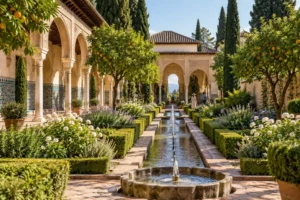
The courtyard combines architecture, water, vegetation, and decoration.
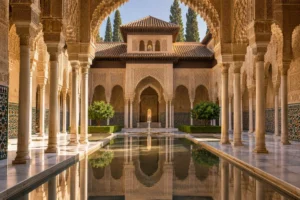
At ground level, delicate arches rise from slender columns. Above them are wide areas of yesería, or carved plaster, filled with geometric patterns, vegetal motifs, heraldry, and inscriptions.
Ceramic alicatado covers lower wall surfaces, while the central water feature creates a long reflective axis.
Nothing works entirely on its own.
The water reinforces symmetry. Plaster catches changing light. Tilework protects the lower walls while adding color and repeating geometry. Doorways frame views into adjoining rooms.
Later modifications also altered the upper levels, meaning visitors are looking at several periods simultaneously rather than a perfectly preserved 14th-century composition.
That layered appearance is part of the couryard’s appeal.
The Hall of Ambassadors Turns Decoration Into Royal Power
Continue from the main courtyard toward the Salón de Embajadores, or Hall of Ambassadors.
This was one of the palace’s major ceremonial and throne spaces, so its decoration had to impress anyone entering it. The room is organized around a square plan, but the visual focus rises toward an extraordinary wooden dome.
Official archaeological documentation for the Alcázar associates the great domed ceiling with the 14th-century development of Pedro I’s palace and records a construction date connected with 1366.
Look below the ceiling and the room becomes even more complex.
Arabic inscriptions, geometric decoration, plasterwork, tiled surfaces, arches, and royal symbols occupy the same visual environment. Instead of separating Christian authority from Islamic artistic traditions, the architecture intentionally brings them together.
This is one reason Mudéjar design can be misunderstood.
A room may look strongly Islamic to modern visitors, but its function and political message could belong entirely to a Christian royal court.
In Seville, visual culture frequently crossed religious boundaries more easily than modern categories suggest.
Plaster, Tiles, and Timber Created a Different Kind of Luxury
Medieval royal luxury did not always depend on marble and expensive stone.
Mudéjar craftspeople could transform relatively modest materials into remarkably detailed surfaces.
The Palace of Pedro I contains extensive ceramic panels, ornamental plaster, painted decoration, timber construction, and complex wooden ceilings.
The Alcázar’s own educational and conservation publications highlight alicatados, yeserías, carpentry, mural painting, and interlaced ceiling compositions as essential parts of the palace’s decorative system.
Plaster was particularly effective.
While wet, it could be molded or carved into dense patterns. Once installed, shallow relief created constantly shifting shadow, making walls appear deeper and more intricate than their materials might suggest.
Glazed tiles created a different effect. Small pieces could be assembled into stars, polygons, borders, and interlocking patterns with vivid color.
Wooden ceilings added yet another layer. Geometric carpentry made overhead surfaces part of the decoration rather than simply structural necessities.
The combined experiance is almost immersive: pattern surrounds you from floor level to ceiling.
Arabic Inscriptions Are Part of the Architecture
Visitors often notice Arabic writing in Pedro I’s palace but assume it must survive from an earlier Muslim building.
Much of it belongs to the Mudéjar decorative program itself.
This is one of the most revealing details in the entire complex. Arabic calligraphy remained prestigious enough to decorate a palace commissioned by a Christian king, demonstrating how deeply Islamic artistic language had become integrated into Iberian court culture.
Inscriptions work visually as well as linguistically.
Long bands of script create horizontal lines that organize walls between tiles, arches, and plaster panels. From a distance they function almost like geometric borders; up close, they become writing.
That combination of language and ornament makes Mudéjar decoration different from purely figurative European traditions.
When visiting, do not concentrate only on the largest arches. Follow the narrow bands between architectural elements. Some of the most intresting evidence of cultural exchange appears in spaces that initially look like decorative borders.
Courtyards Reveal an Islamic Approach to Space
Mudéjar influence is not limited to surface decoration.
The organization of Pedro I’s palace also draws on older Andalusi traditions. Instead of designing everything around one monumental façade and long corridor, rooms gather around courtyards.
This arrangement provided privacy, shade, ventilation, controlled access, and intimate connections with water and gardens.
The official Alcázar guide divides Pedro’s palace into an official zone centered on the Patio de las Doncellas and a more domestic area around the Patio de las Muñecas.
Movement is therefore gradual.
You pass through entrances, halls, courtyards, smaller chambers, and framed doorways rather than seeing the whole building immediately. Important spaces reveal themselves in stages.
That rhythm resembles palace traditions found elsewhere in Al-Andalus.
It also works beautifully in Seville’s climate. Enclosed patios, water, shade, and limited exposure to direct sun help create more comfortable interior environments during hot months.
Here, aesthetics and practical design are closely connected.
Compare the Mudéjar Palace With the Gothic Palace
One of the best ways to understand Mudéjar architecture is to compare it with another building only a short walk away.
The Alcázar also contains a Gothic palace associated with Alfonso X, constructed after Christian rule was established in Seville. The difference in atmosphere is immediate.
Gothic spaces generally feel heavier and more structural, with large halls and architectural forms connected to Christian Europe.
Pedro I’s palace feels lighter and more layered. Decoration covers surfaces, courtyards organize circulation, and arches, water, tiles, timber, and plaster constantly interact.
Neither building tells the complete history of the Alcázar.
Together they reveal something more important: Seville was not moving neatly from “Islamic” architecture to “Christian” architecture. Several traditions existed side by side, and royal patrons could choose between them – or combine them.
Later Renaissance and Baroque changes added even more complexity.
That is why the Real Alcázar is better understood as a living architectural archive than a palace representing one single style. UNESCO specifically recognizes this coexistence of Almohad, Mudéjar, Gothic, Renaissance, and later traditions.
How to Spot Mudéjar Details During Your Visit
The easiest mistake at the Alcázar is moving too quickly.
Instead of photographing every room, choose a few surfaces and examine how they are constructed. Look first at the lower wall and identify ceramic patterns. Move upward into plasterwork and see how geometry blends into leaves, inscriptions, or heraldic emblems.
Then look at the ceiling.
Woodwork is easy to overlook because most visitors concentrate on eye-level decoration. Yet some of the finest craftsmanship is overhead.
Doorways are equally important. Stand back and notice how one arch frames another courtyard or room. This deliberate layering makes even small spaces appear deeper.
Finally, compare Pedro I’s palace with surviving Almohad areas and later Christian additions. Mudéjar makes much more sense when you see it as part of a continous architectural conversation rather than an isolated style.
Give the palace time. Its details become more rewarding the longer you look.
Discovering Mudéjar architecture in Seville’s royal palaces reveals a medieval world where artistic traditions did not fit neatly inside religious or political borders.
The Palace of Pedro I shows Christian royal power expressed through Islamic-derived courtyards, Arabic inscriptions, geometric tilework, carved plaster, wooden ceilings, water, and garden planning.
Nearby Gothic and later Renaissance spaces make the cultural mixture even easier to recognize.
The Real Alcázar is therefore more than a beautiful palace. It is evidence of how craftsmen, rulers, and architectural ideas moved between cultures and continued evolving for centuries.
When you visit, slow down. Study one tiled wall, follow an inscription, look upward at the ceilings, and compare the different courtyards. The smaller details are often where Seville’s most fascinating architectural history becomes visible.